
Food for the Soul: Henri Rousseau: A Painter’s Ambition
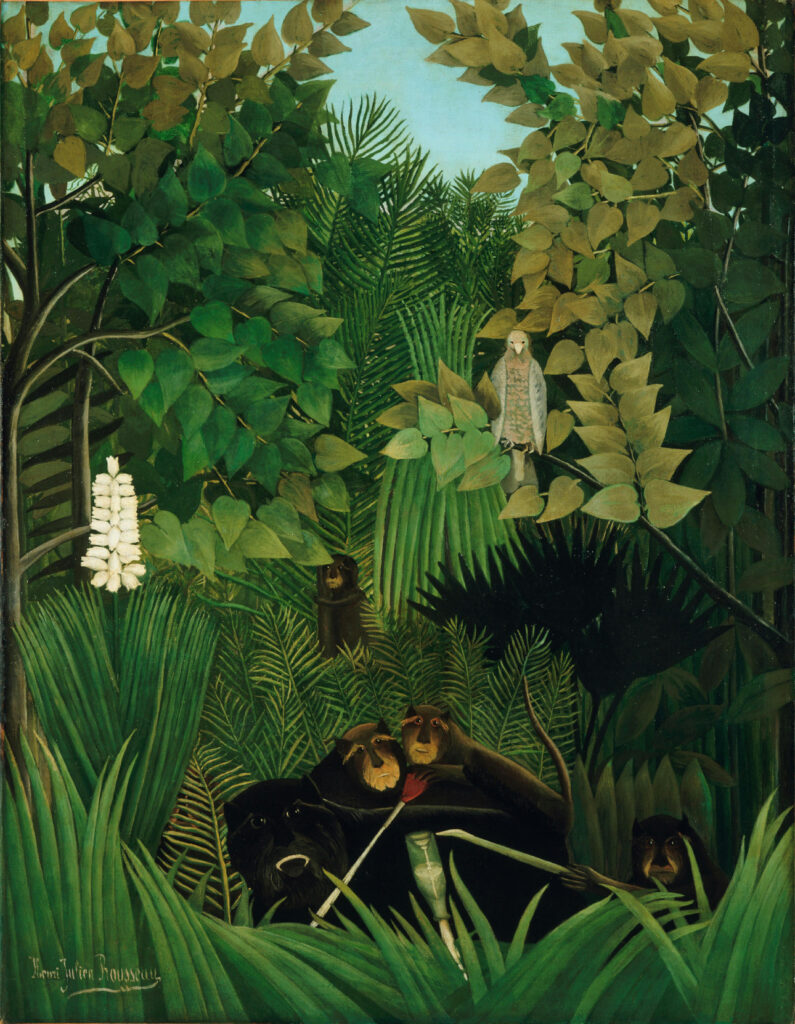
By Nina Heyn
When we think of Henri Rousseau (1844-1910) we evoke his paintings of jungles and monkeys, which are indeed what made him immortal, but this self-taught painter started with something else. He embarked on the path of an artist when he was a middle-aged man holding the mundane job of tax collector at the Seine port (“customs officer” was the erroneous but catchy moniker given to him by the poet Alfred Jarry).
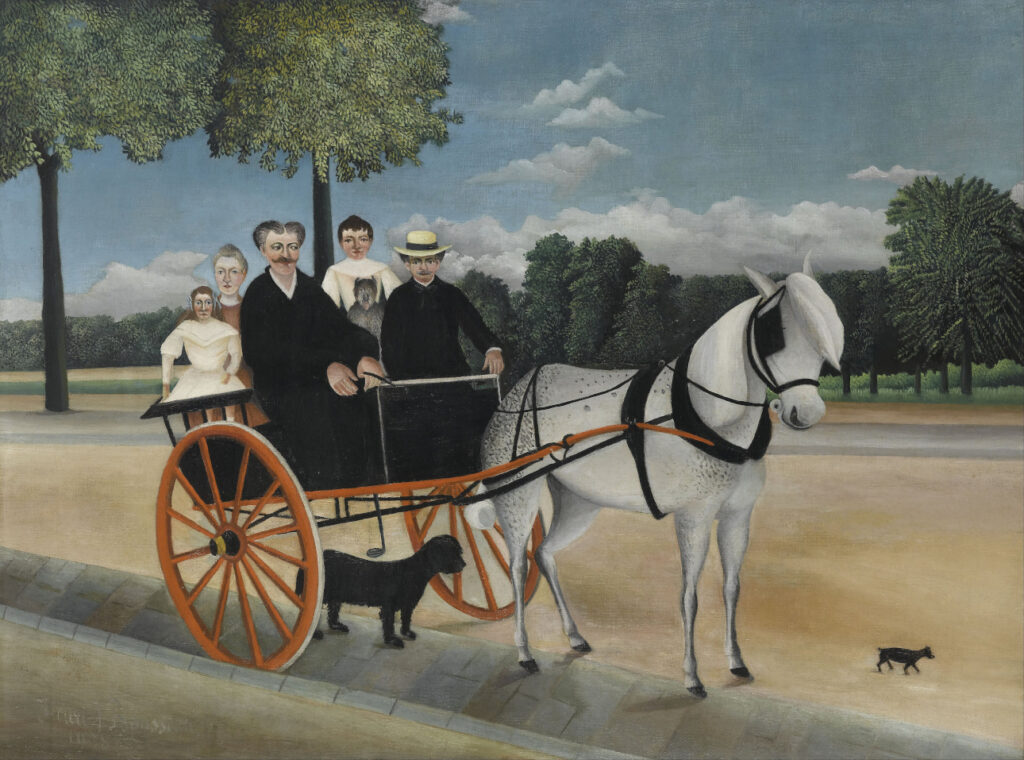
His early works depicted his surroundings (the Paris suburb of Laval), portraits of his family, and his first customers: a grocer to whom he owed money or the parents of a small girl who wanted her portrait. The picture above, called Père Junier’s Cart, is as unsophisticated as it is utterly charming—an entire family is on an outing in a simple two-wheel cart, with one grey terrier who scored seating, and two other dogs, perhaps strays, running next to the cart. The horse sports a jaunty mane, and the trees have every leaf painted in. While this painting helped Rousseau pay his grocery bills, it still remained in the category of “naïf art” and could not compete with the “fine art” that filled the Louvre and Luxembourg museums. However, Rousseau was unshaken in his conviction that his style had its place among French culture. In fact, he was quite obsessed with achieving professional recognition.
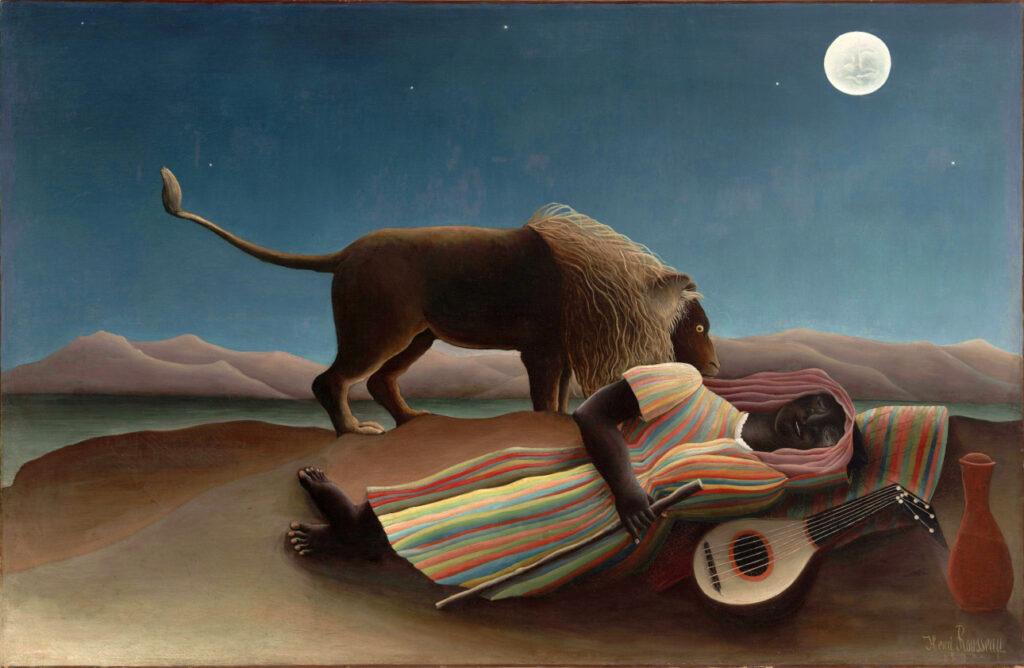
In 1885, he submitted his first picture to the Salon, and a few years later he quit his day job to devote himself to painting, surviving on his modest pension. Rousseau entered competitions to decorate the halls of three different suburbs. To no avail—other painters were chosen for the lucrative commissions and city prizes. When he offered to sell one of his most poetic works—The Sleeping Gypsy—to the city of Paris, he was summarily turned down. By the way, this is the same canvas that in 1926, 16 years after the artist’s passing, was exuberantly praised by Jean Cocteau and then sold for 520,000 francs—more than paintings by Corot and Delacroix. Rousseau also vigorously pursued recognition with state institutions like the Salon (the annual, official exhibition that led to patronage and commissions), but his decidedly non-academic art would more often land him with access just to the Salon of Independents, where he exhibited for years.
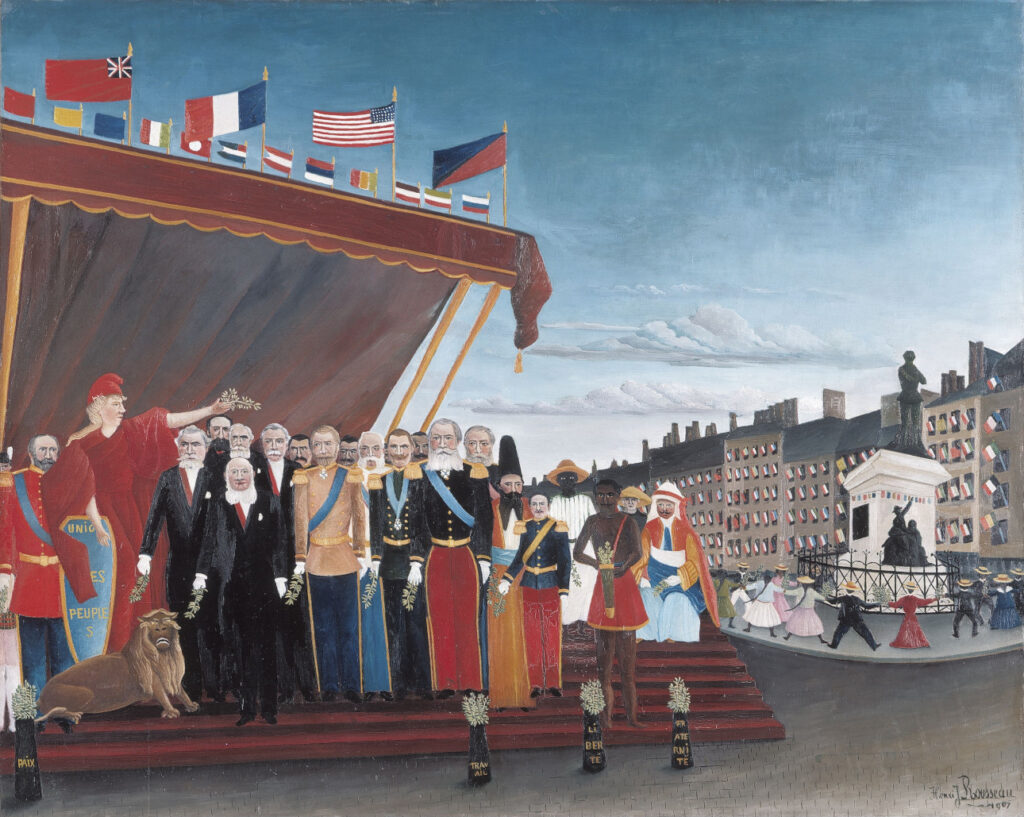
A case in point is an interesting large canvas with a very long title: The Representatives of Foreign Powers Coming to Greet the Republic as a Sign of Peace. He managed to get it exhibited at the Salon, hoping that it would be purchased for the State collection, especially because its display coincided with the Hague Peace Conference. The people portrayed in this imaginary gathering included all the heads of state and French politicians. However, the official purchasers ignored him, and the painting was first acquired by the marchand Ambroise Vollard and later by his client Picasso, who kept this canvas throughout his life.
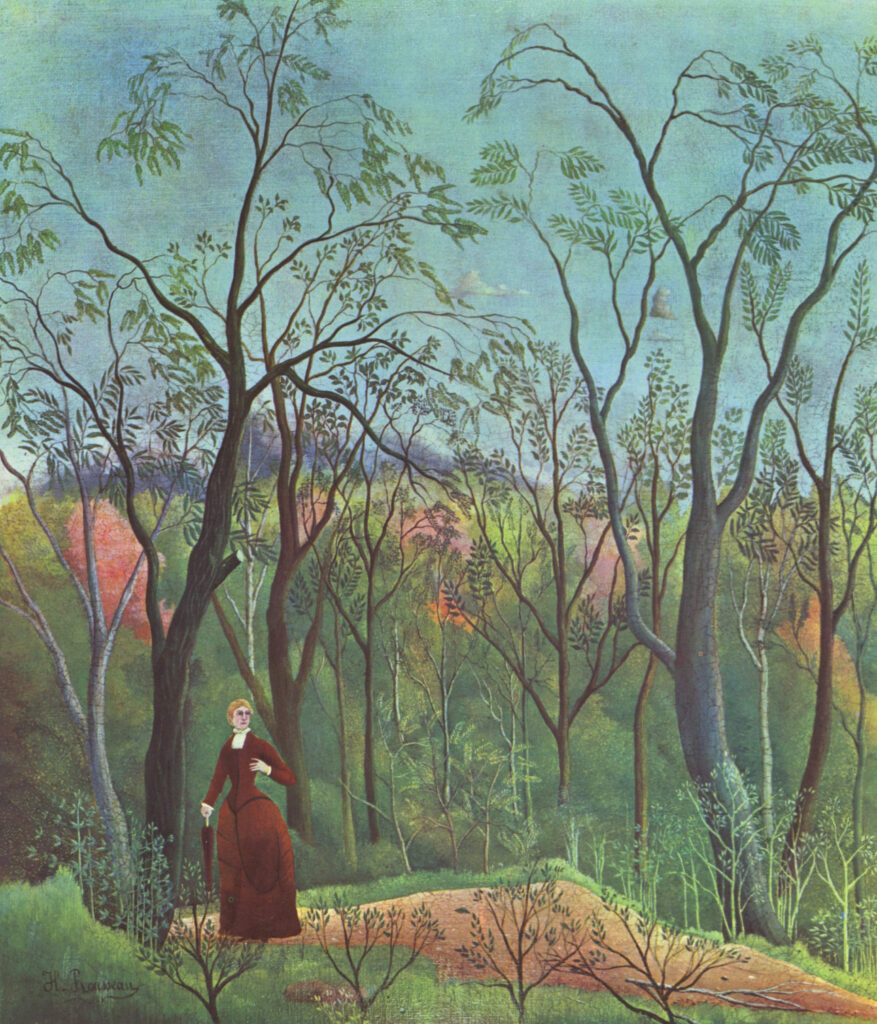
As time went on, Rousseau’s portraits acquired more and more landscape in the background, while the portraits themselves ceased to be straight representations of people. An example of such a transitional picture would be A Walk in the Forest. It is a picture of a woman, but not only is she enveloped and dominated in an exotic-looking forest, with red streaks of the setting sun peaking through the branches, but there is also a hint of a narrative here, with the woman looking back, as if startled.
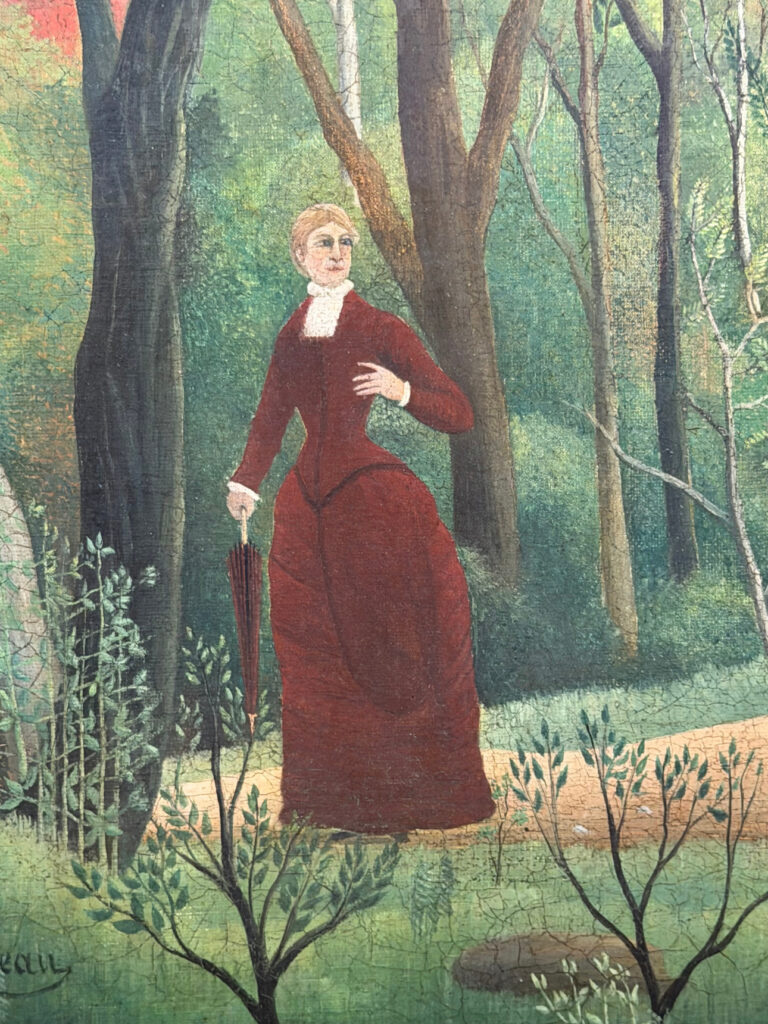
In terms of the mood of surprise and mystery (is she hearing her name being called? is she startled by a forest noise?), this picture is not far from Rousseau’s most famous pictures—those of his jungle adventures and nocturnal oddities. Rousseau named these compositions “portraits in the landscape,” and he was very proud of his new narrative style.
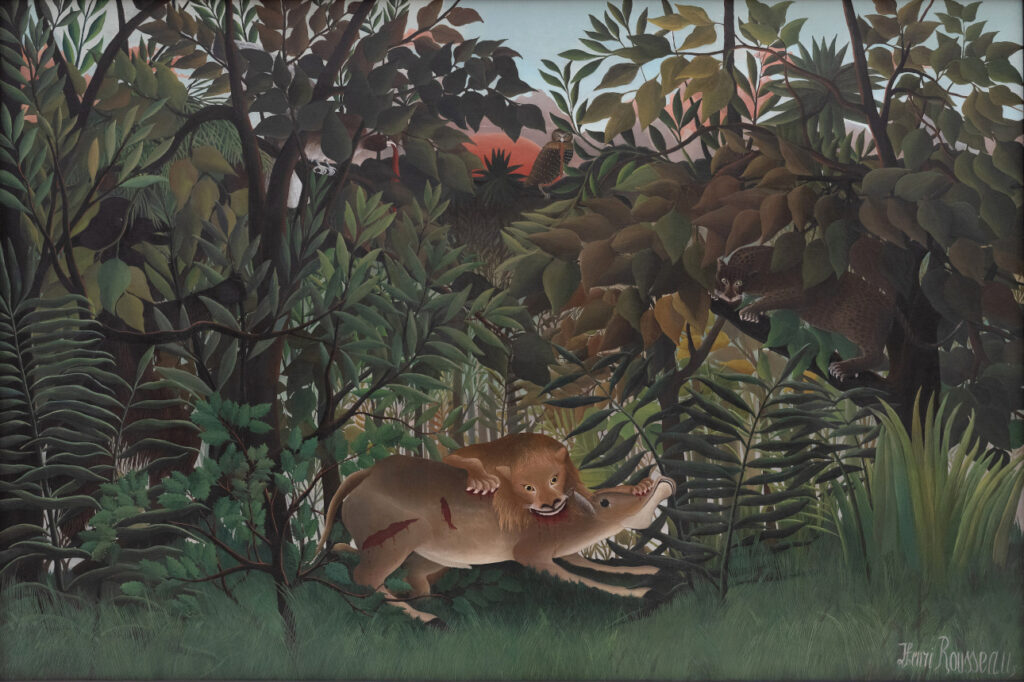
Many painters in their artistic evolution start painting larger and larger formats as time goes along, and this was also the case of Rousseau, who became emboldened in his themes and sizes. He also realized that his green jungles, wild beasts, and mysterious characters would seize the imagination of his Parisian clients much more than tame views of the Seine and city parks. His wilderness fantasies are what we adore these days and they are what aroused the enthusiasm of artists such as Félix Vallotton, Jean-Léon Gérôme, and Picasso, as well as poets like Apollinaire and Jarry, and dealers like Vollard and Paul Guillaume. The artists and critics had recognized early on what the Salon officials and general public took much longer to see—the enormous visionary power of this talent hidden in the person of a most unprepossessing man.
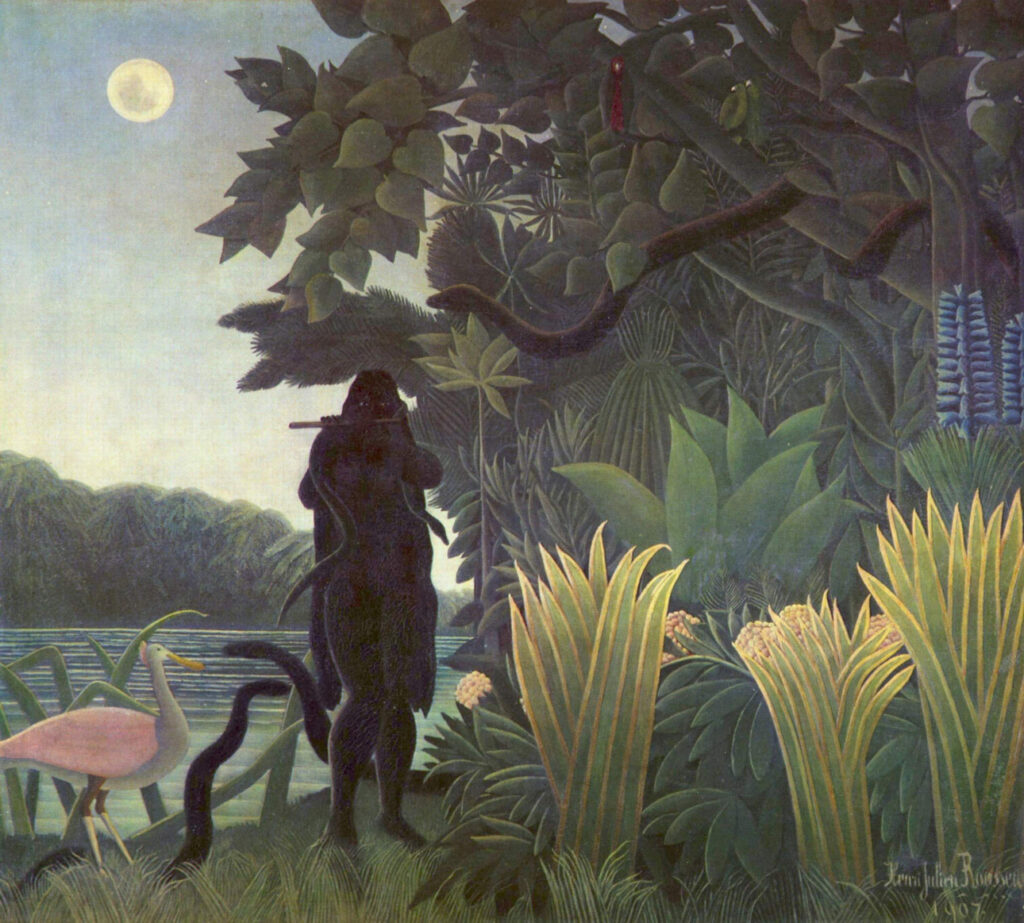
Three paintings—The Snake Charmer, The Sleeping Gypsy, and Unpleasant Surprise—are the heart of the current Paris exhibition, Henri Rousseau: A Painter’s Ambition. Ordinarily, they are in the collections of three different museums, and this is the first time that the one held by the Barnes Foundation has been able to join the other two. These three large canvases are presented at the exhibition as the artist’s “manifesto paintings”: the ones that best express his love of the unusual and the exotic, the unbridled originality and imagination that fascinated “professionals” such as Picasso and Gérôme, and Rousseau’s unshaken conviction that his pictures deserved recognition in the art world.
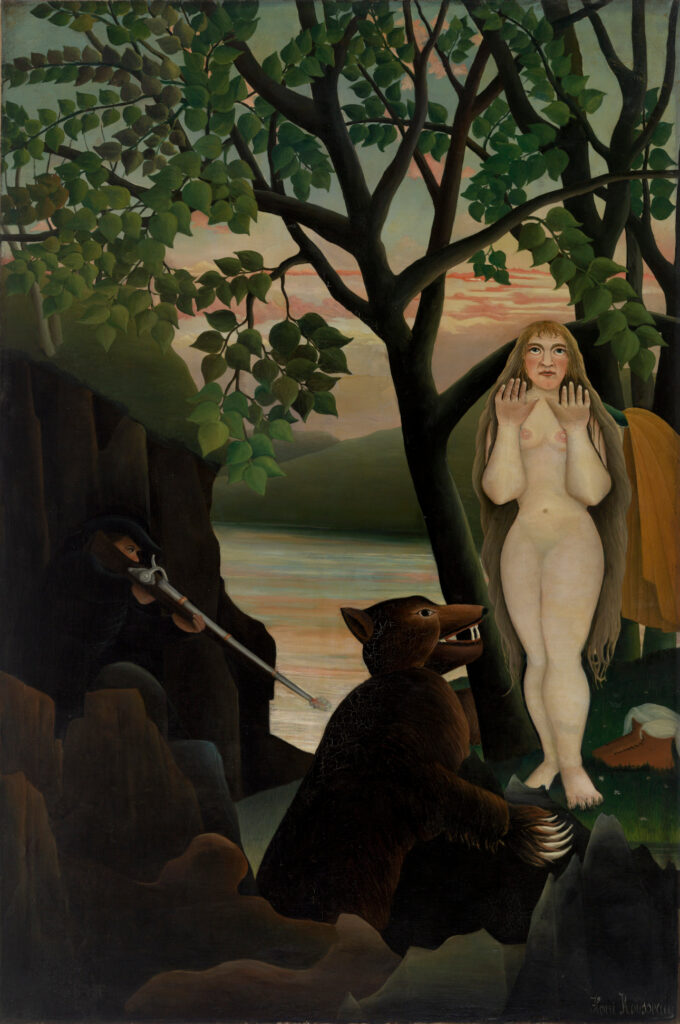
He was quite right that his art was important, even though recognition came far too late for him. Money troubles (and even a sordid court case of a forged check) haunted him until the end, and he was buried in a pauper’s grave. His paintings fared much better. While during his lifetime they fetched only modest sums and did not interest the state museums, within a decade of his passing in 1910, his pictures started growing in stature. His art was championed by several collectors, like the American Albert Barnes and the Russian Sergei Shchukin, as well as some dealers like Paul Guillaume. Unpleasant Surprise, the painting that Rousseau failed to sell to the Ministry of Fine Arts in 1901, eventually was purchased in 1924 by Barnes for 525,000 francs. In 2003, a painting titled Les Flamants sold in New York to a private collector for $43.5 million. Rousseau’s art inspired Max Ernst (Garden Populated with Chimeras, 1936 version), Fernand Léger, and even Giorgio Morandi. These days, it would be hard to find a graphic designer who has not been somewhat influenced by familiarity with Rousseau’s jungles.
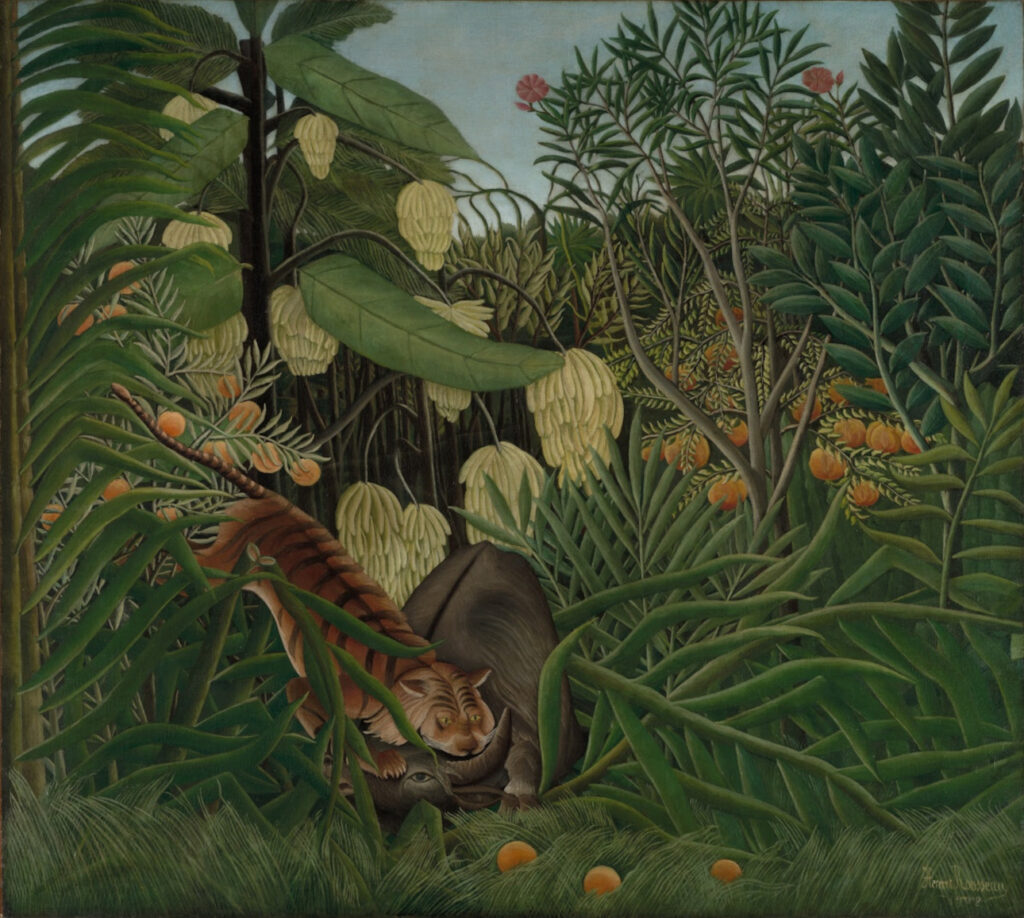
The exhibition Henri Rousseau: A Painter’s Ambition at the Orangerie museum in Paris runs between March 25- July 20, 2026. It was previously shown at the Barnes Foundation in Philadelphia.