
Food for the Soul: King Francis I – Renaissance Mon Amour
By Nina Heyn
During a trial in 1913, when Vincenzo Peruggia was asked why he stole the Mona Lisa from the Louvre, he said that he wanted to return the masterpiece to its rightful owners, that is, the Italian nation. He may have been fashioning an explanation to cover his theft, but his argument matched the belief of a lot of Italians, who assumed that because it was painted by Leonardo da Vinci, it must belong to Italy.
Too little knowledge is a dangerous thing. The rightful owner of the painting was, in fact, the French nation because this panel was purchased around 1519 from da Vinci’s pupil Salai by the king of France for the tidy sum of 4000 gold écus. The king in question was Francis I (known in France as François 1er; 1494-1547), one of the most powerful Renaissance rulers. He invaded northern Italy in 1515, deposing the duke of Milan but offering the elderly Leonardo da Vinci a safe haven in the comfort of a French château. Da Vinci spent the last three years of his life there, designing court events and decorations, doing architectural projects (the famous double spiral staircase at Chambord is probably a Leonardo design), and painting or perfecting his earlier pictures, including the Mona Lisa.
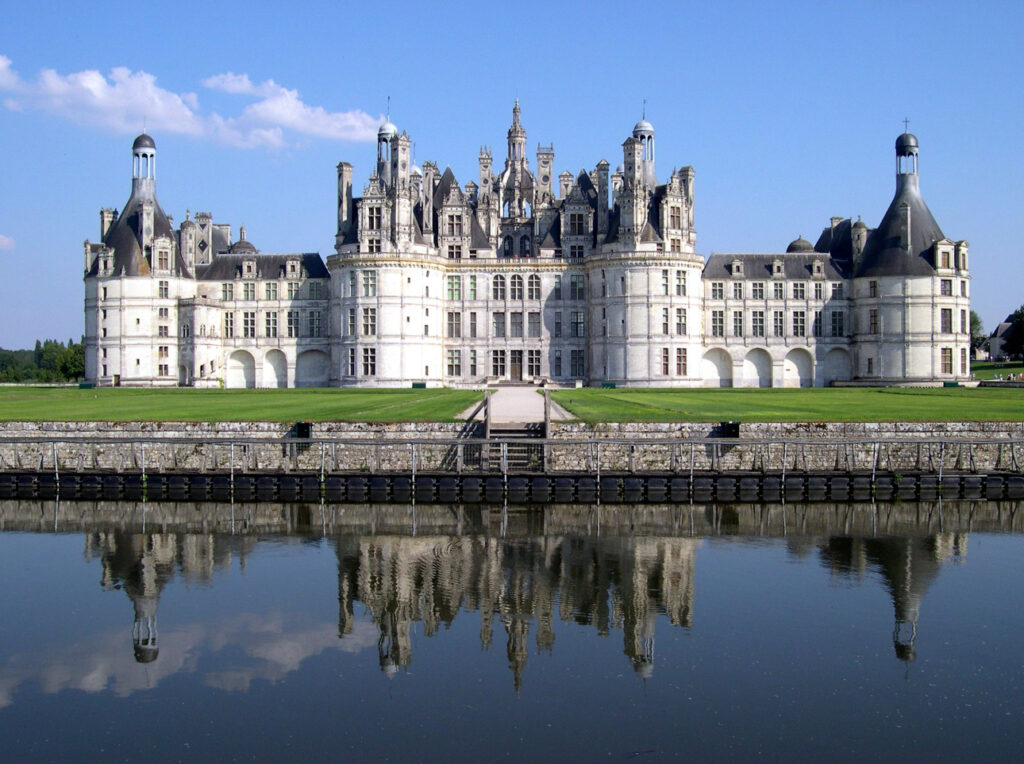
For the French, Francis I occupies a position in national history as one of the grandest kings. As a ruler, he gained some lands like Lombardy and Brittany for the French territory, but he was also and especially a refined patron of the arts and literature who brought Renaissance culture to France. His architectural legacy includes the royal residence of Fontainebleau and the castles of Chambord, Azay-le-Rideau, and Blois.
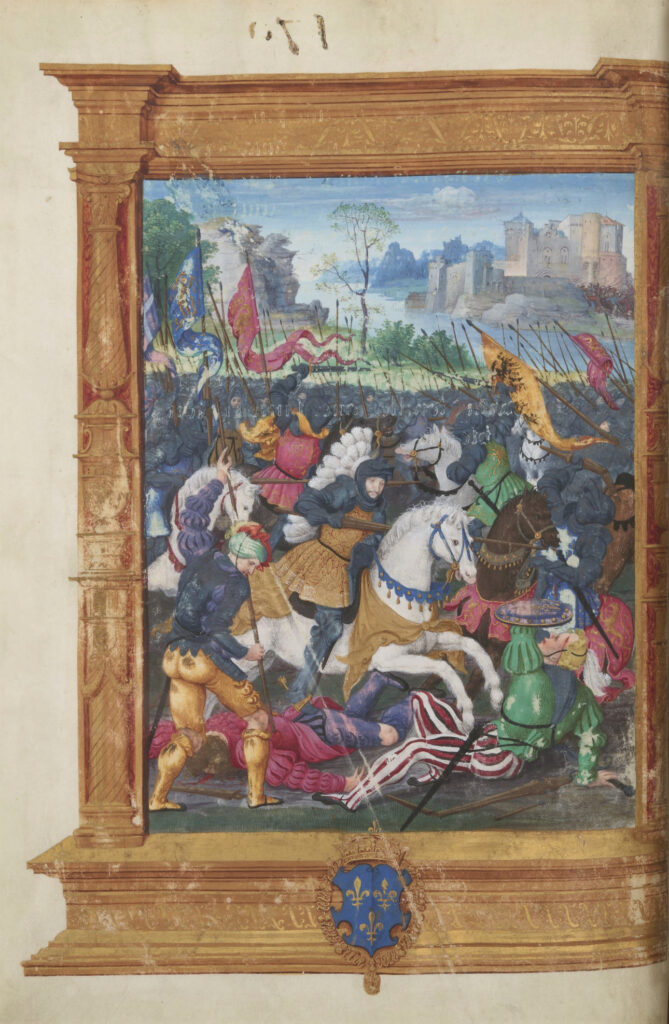
It was not easy to go through life in the 1500s, even if you happened to be born as a royal. Francis’s life was full of truly dramatic reversals. He started his reign on a high note by leading the victory at Marignano, which brought France the lands of Lombardy and the reign over the dukedom of Milan, establishing the young king as a leading warrior knight of Europe.
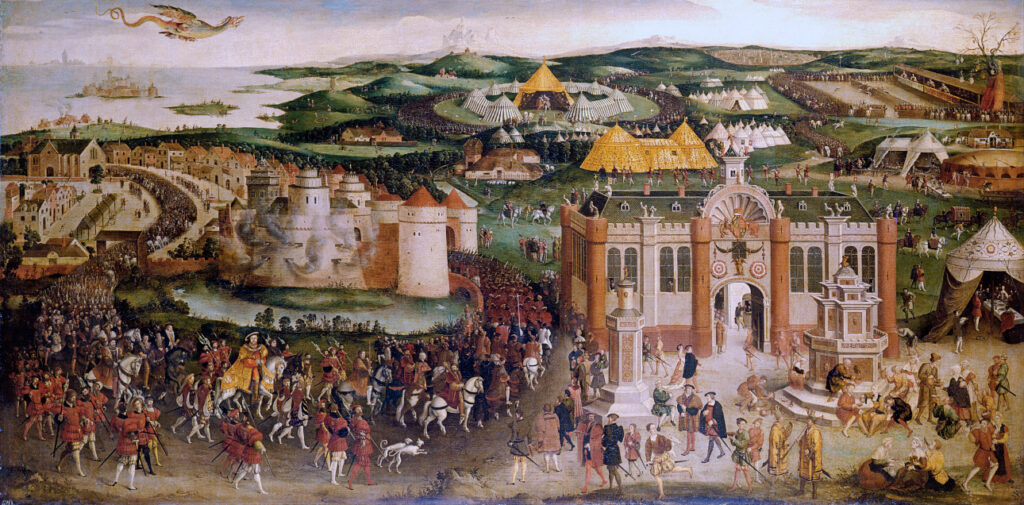
British School. The Field of the Cloth of Gold, c. 1535. Oil on canvas. Royal Collection Trust, Hampton Court, UK. Photo: Wikimedia Commons
Soon, this military coup was followed by an attempt to ally with the energetic new King Henry VIII of England and to establish a good relationship with the Holy Roman Emperor Charles V. The three kings’ grandstanding summit is known as the “Field of the Cloth of Gold”—so dubbed due to the amount of gold accoutrements and cloth displayed by the monarchs and their entourages.
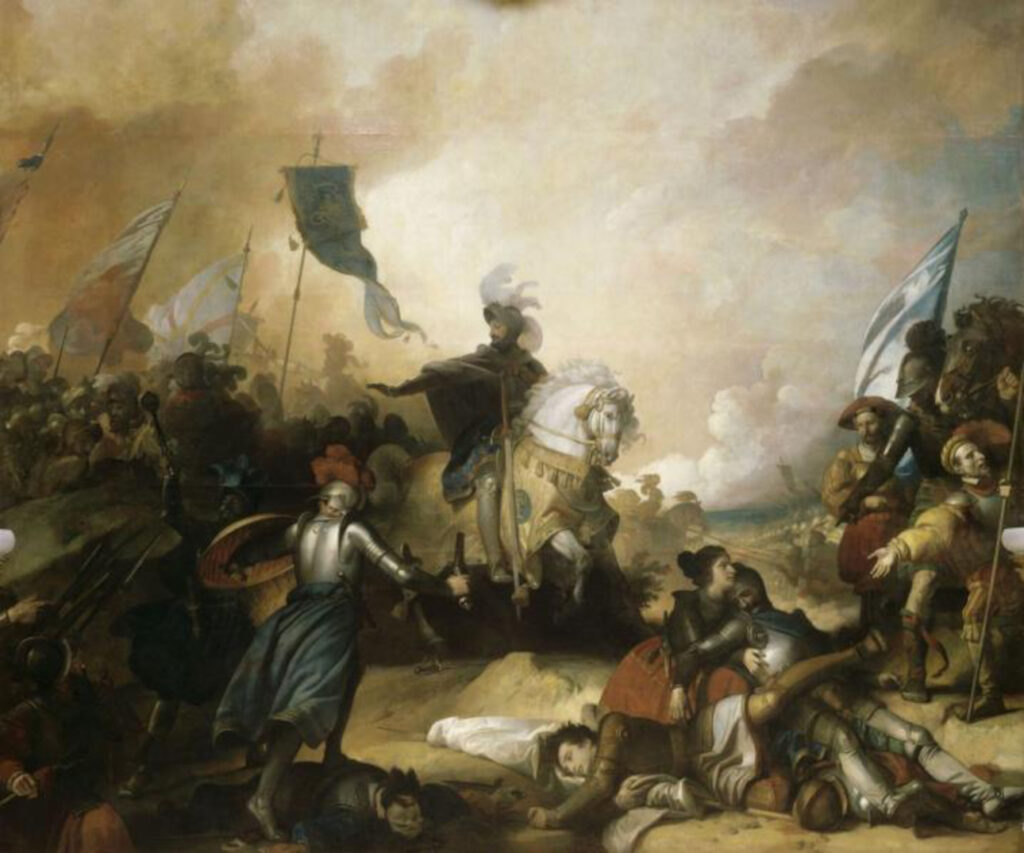
However, neither the Marignano victory nor the glittering diplomatic mission of the Field of the Cloth of Gold could guarantee lasting peace to France. Soon after, the three rulers were again at odds, and the territory wars had resumed.
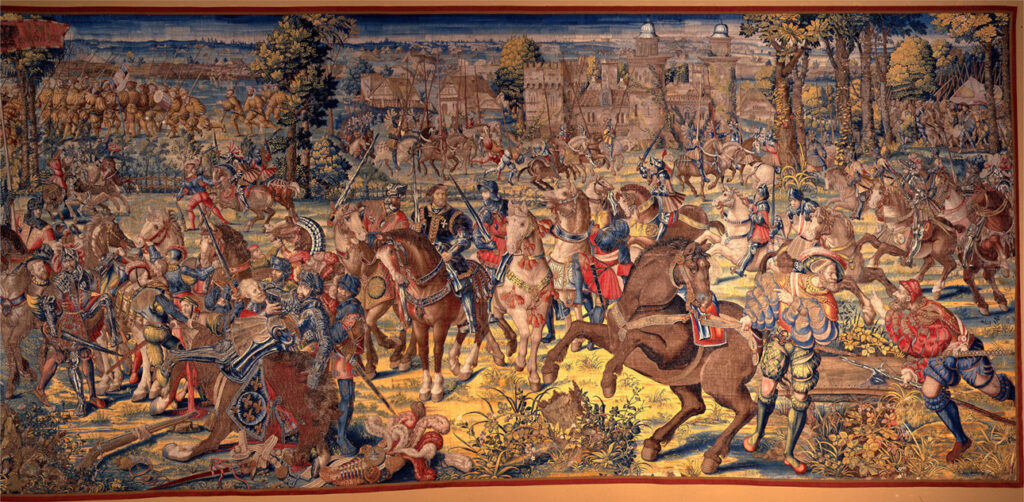
In 1525, barely 10 years after the Marignano glory, came the lowest point in the king’s fortunes. Obsessed with the desire to reconquer Lombardy, the king let his army fight against the Habsburg forces of Charles V. Francis was seized on a battlefield by the soldiers of the King of Naples after losing 15,000 soldiers, and he became the prisoner of the Holy Roman emperor, forced to sign a treaty in Madrid where he was being held captive. His freedom cost France and his family dearly: Francis lost Flanders, Milan, and Burgundy, and he had to leave two of his sons as hostages until they were ransomed a year later.
The military legacy of Francis has been judged in various ways, depending on the nationality of historians and the century in which they wrote their opinions, but at least from the point of view of French art history, the consensus is that this is the king who created the first important art collection in France.
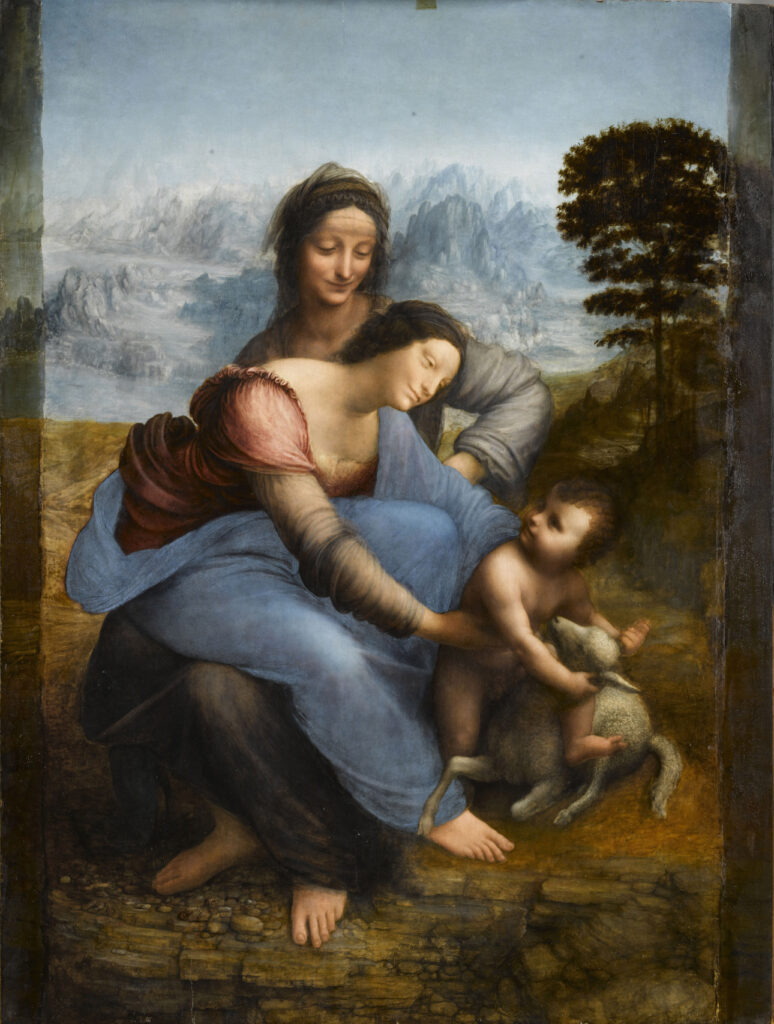
For art historians, especially those connected to the Louvre, Francis’s collection is a source of some of the most famous and outstanding Italian artworks, led by the Mona Lisa and four other da Vinci masterpieces. One of them is Virgin and Child with Saint Anne, a panel which was probably originally commissioned by Louis XII (Francis’s predecessor and cousin) to mark the birth of his daughter Claude (who later married Francis), but it had always remained with the artist, and da Vinci eventually took it with him to France. It is the most complex of da Vinci’s compositions but, like many of his works, it remains unfinished. The Virgin’s red robe is done down to the smallest detail, but the blue cloak is barely marked with an under-painting. It is still a magnificent work, with a dreamy mountainous landscape and meticulous stone work as background to the three figures.
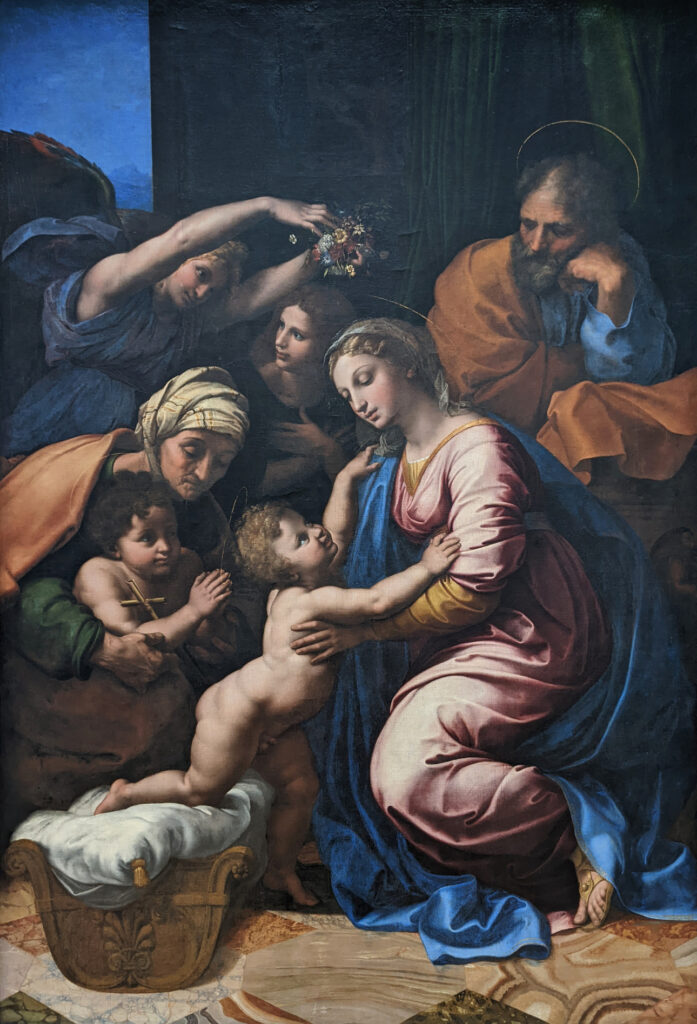
The other genius of the Italian Renaissance, Raphael, is represented in this collection by works from different phases of the artist’s life. Raphael’s boss, Pope Leo X, hoped that Francis would take up a crusade against the Turks and, to reinforce the suggestion, he kept sending diplomatic gifts, one of them being a large canvas known as the Grand Holy Family of Francis I. There is ample diplomatic correspondence attesting to Raphael’s progress in creating this picture—the pope was using this artwork as a lever to keep pressure on the king. The Louvre also has in its galleries other Raphael paintings from the king’s collection, such as St. Michael Vanquishing Satan and a famous Madonna picture known as La Belle Jardinière.
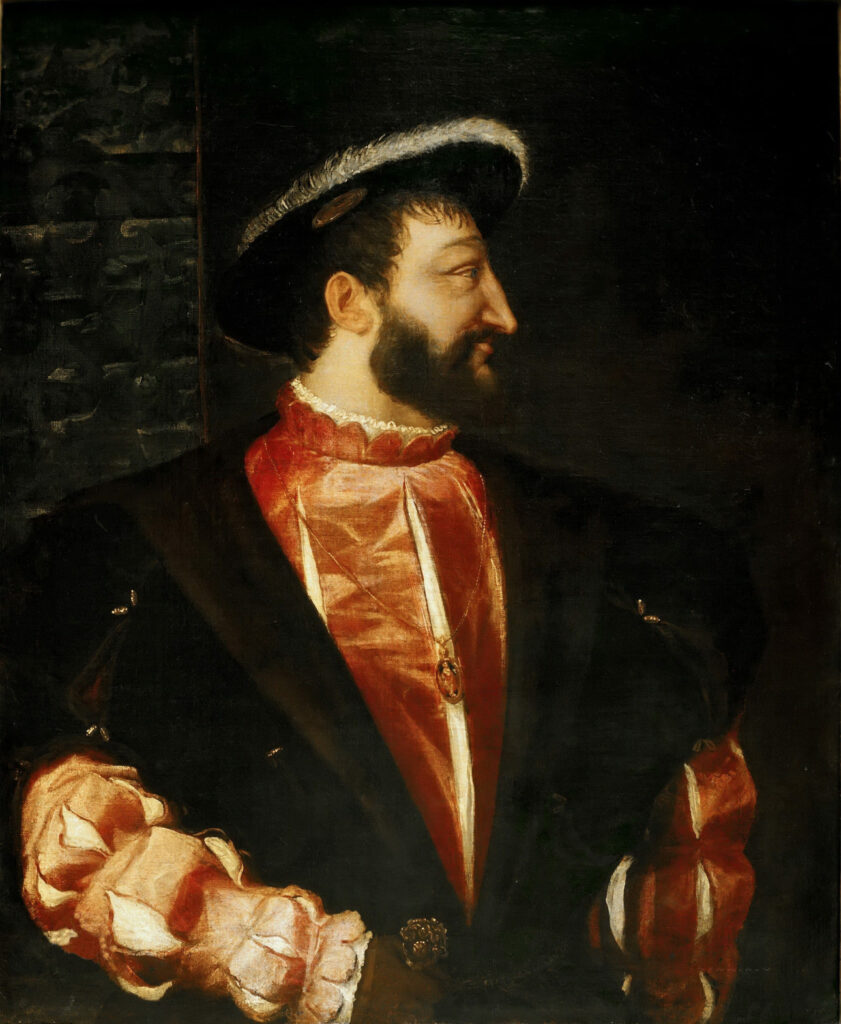
The king’s preference for Italian art was widely known in Europe. Francis I corresponded with the poet Pietro Aretino, who was one of the closest friends of Titian. Aretino brokered a commission for a royal portrait, even though Titian never met his model. The resulting picture has a slightly awkward side profile on top of a ¾ body view that showcases Titian’s mastery in rendering velvet cloth. It is believed that Titian may have been using a medallion sculpted by Benvenuto Cellini, which would explain the odd facial profile. The painting itself wandered in and out of the royal collection, finding its way in the next century to the personal collection of Cardinal Mazarin, the powerful éminence grise of King Louis XIII. The king’s successor, the Sun King Louis XIV, had to repurchase this portrait in order to have it back in the royal treasury.
Speaking of Cellini—here is someone whose artistic legacy is closely aligned with that of Francis I. Encouraged by the cultural coup of having persuaded the elderly da Vinci to move to France, the king continued “importing” the best of the best of the Italian art scene to his court. In 1540, he invited Cellini, a sculptor and goldsmith of pan-European renown, to join him at the Fontainebleau residence.
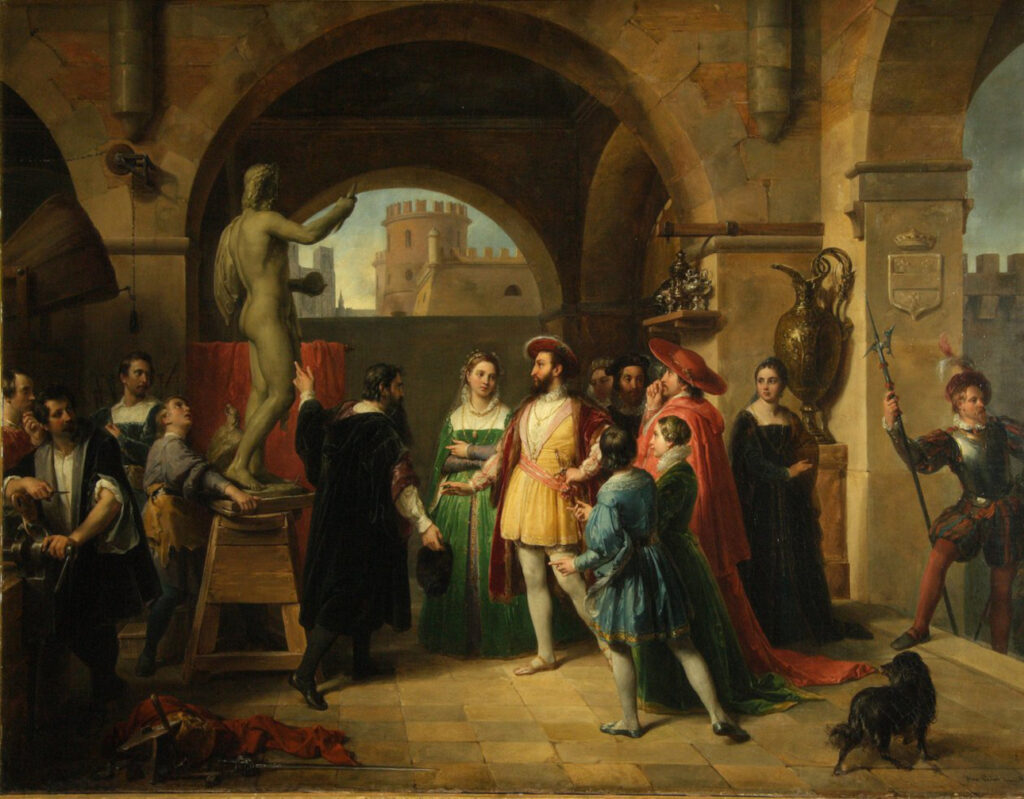
Cellini was fêted and much appreciated at Francis’s court, as depicted in this apocryphal 19th-century painting by Franceso Podesti.
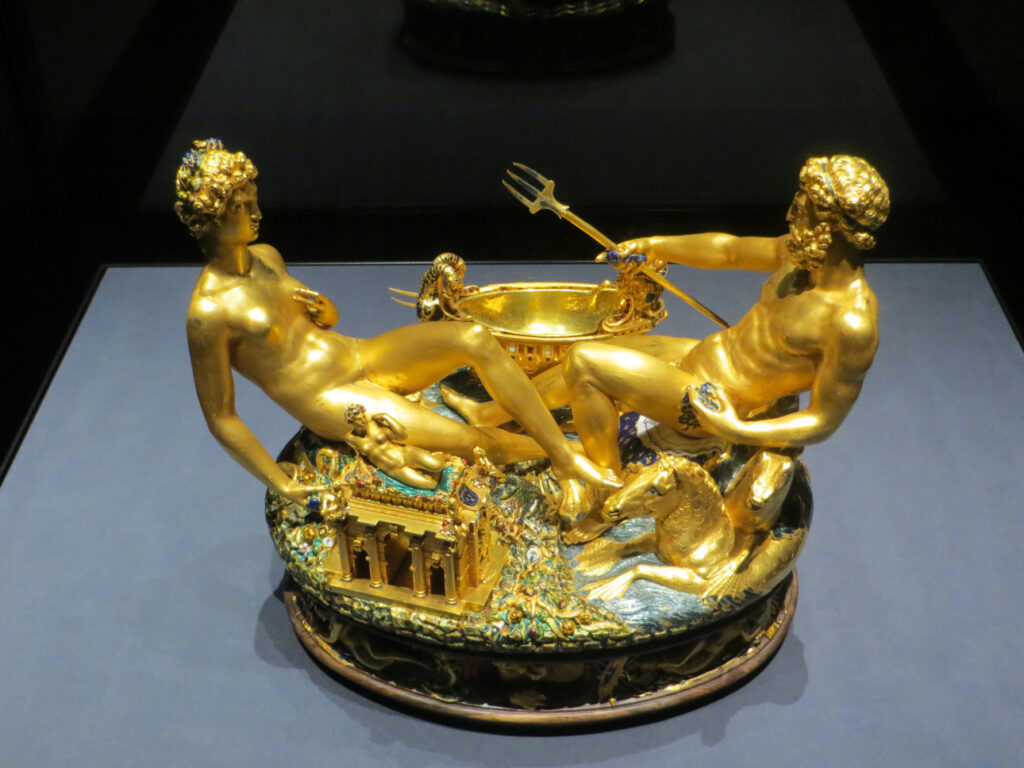
For his royal patron, Cellini created what has survived to our times as the only example of his goldsmith mastery—the large salt cellar now in the collection of the Kunsthistorisches Museum in Vienna. In 2003 it was a subject of one of art history’s most dramatic heists, but has been returned to the museum three years later.
Cellini, an impetuous artist, got on the wrong side of Francis’s mistress, the Duchesse d’Étampes, who complained to the king. In a feudal court, there can be only be one proud peacock, and so the ornery Cellini had to return to his native Florence.
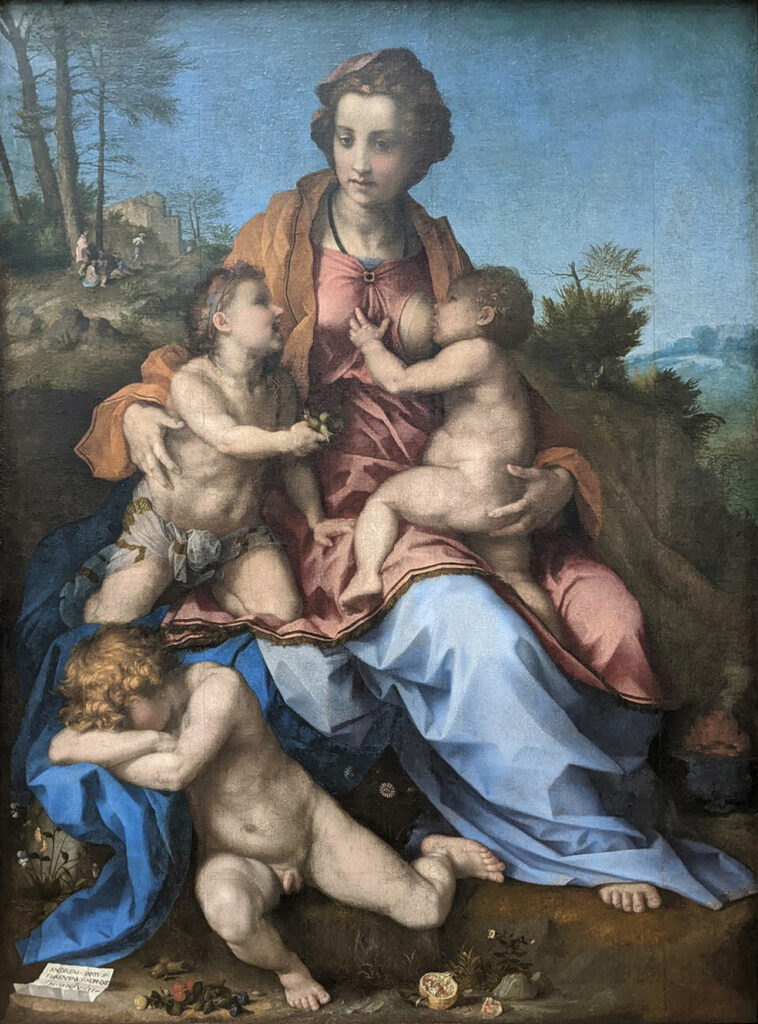
The king invited to his court another Italian master—Andrea del Sarto—who spent his entire life in Florence with the exception of this short time in the service of Francis I. From that period comes another gem of the collection—an allegory of Charity. This figure would traditionally be represented as a mother who feeds and protects her children, with the red robe being a symbol of the flame of love for the people. The del Sarto canvas was painted to celebrate the birth of an heir to the throne, and the face of the mother was perhaps vaguely modeled on the likeness of Francis’s wife Claude.
The painter lasted barely nine months at the French court. After he announced that he needed to pay a short visit to his wife back in Florence, he was given money to purchase some Florentine art for the royal collection. Instead of doing so and hastening back to France, del Sarto used the funds to buy himself a house in Florence, and he never went back to his patron.
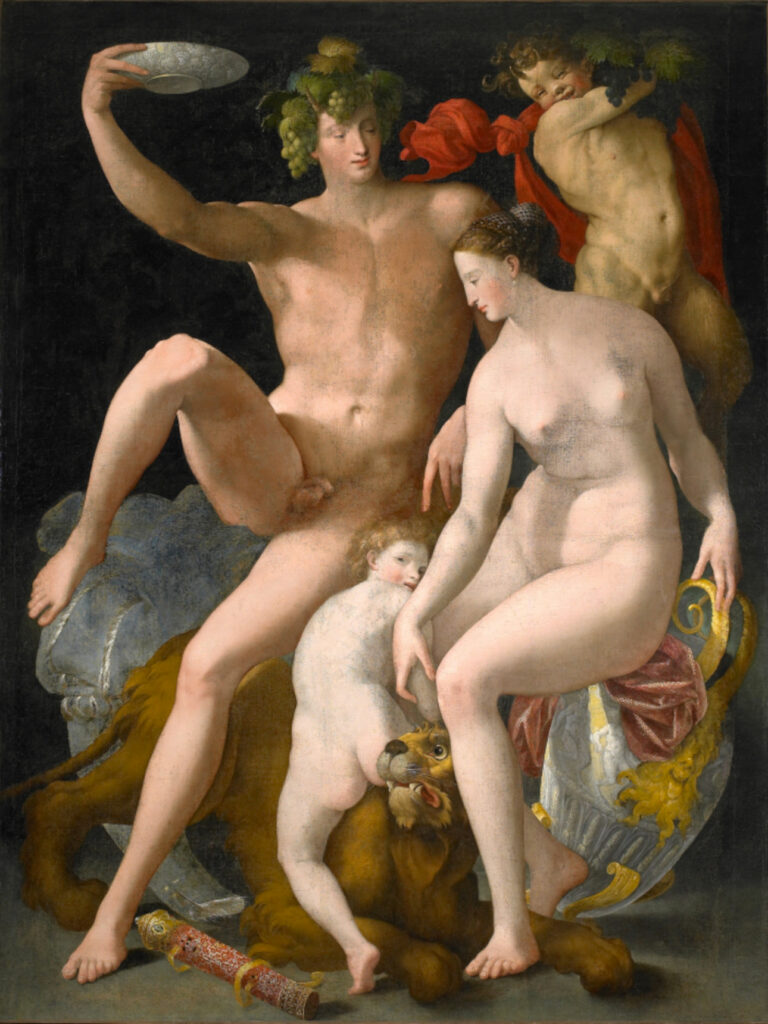
Francis had better luck with del Sarto’s pupil, Rosso Fiorentino, who, together with another Italian painter named Francesco Primaticio, was one of the chief artists decorating the palace of Fontainebleau. Fiorentino remained at the French court until his death, and his imprint on the look of Fontainebleau included creating paintings, frescoes, stucco figures, ceiling ornamentation, and leather embossments on walls—all this in the new Italian Renaissance style that transformed medieval French castles into gracefully rebuilt palaces, decorated with mythological scenes, fruit and flower garlands, and whimsical animals and cherubs. Rosso’s painting of Bacchus, Venus and Amor is a perfect example of the Italian influence on both the style and themes that appeared in the French paintings, decorative arts, and architecture of the period.
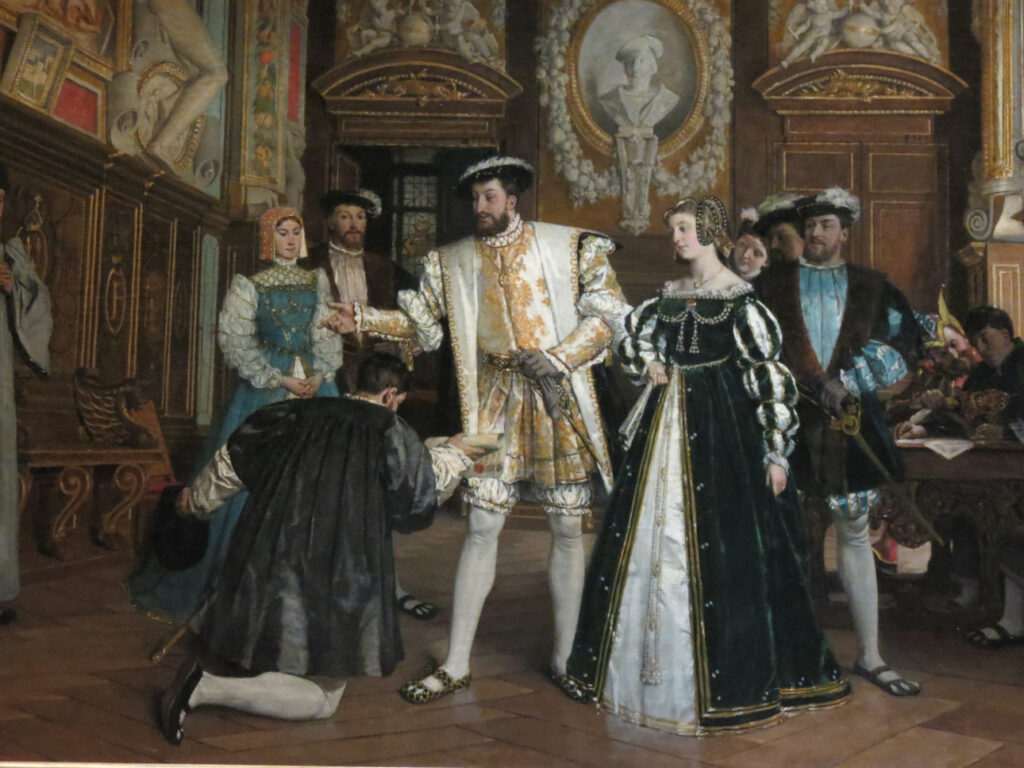
A 19th-century painting by a minor artist named Isidore Patrois (above) illustrates the symbiosis between the king and an artist brought over to raise the style and glory of the king’s rule. A painting with the long and slightly incorrect title of Francis I grants Rosso Fiorentino the benefits of the St. Martin Abbey in compensation for the work on decoration of the Fontainebleau Palace shows Fiorentino being granted an income from an abbey (it was actually Sainte Chapelle, a different abbey, but we can excuse Patrois from inaccuracies 300 years later). Next to the king stands Anne de Pisseleu, the king’s mistress and the very same Duchesse d’Étampes who was the cause of Cellini’s departure from the royal court. The grand gallery shows Rosso’s decorations—frescoes and stuccoes—all created for the greater glory of Francis as patron of the arts.
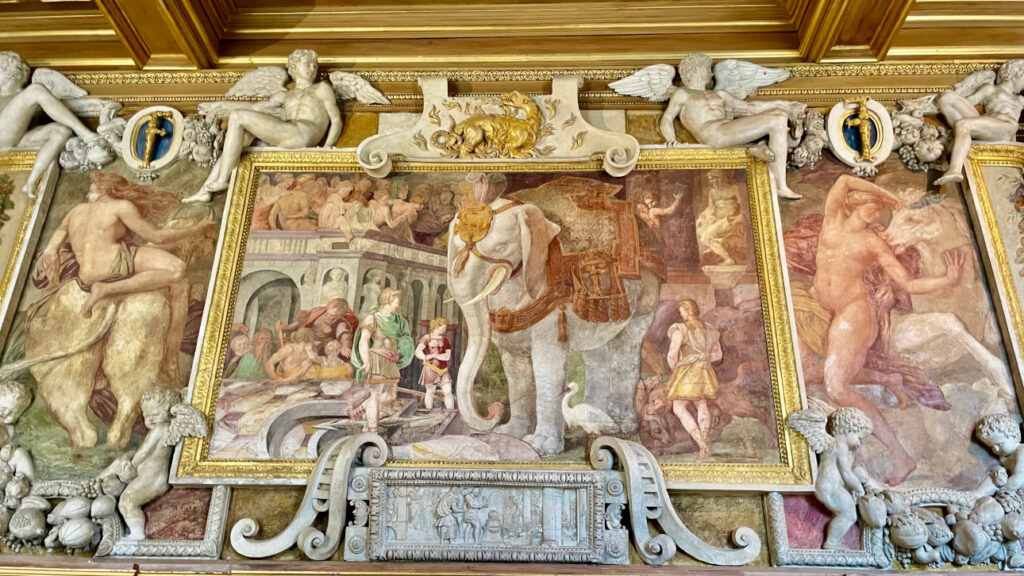
Francis I reigned for 32 years. Despite military setbacks and constant battles over territory and religion, his rule was stable enough for him to concentrate on transforming his residences from drafty siege fortresses into pretty palaces and to create the first collection of artworks that would reflect the sophistication and splendor of his court. His tastes and patronage inspired his courtiers all over France to build in the new style and to commission decorations of a beauty to rival those of Italy. His patronage of writers, philosophers, and poets also opened the doors to new literature and social and political writing. In France, the Renaissance might not have happened at all, or not to this level of sophistication, if not for this monarch who would order anything—artworks, artists, decorations, and ideas to serve his political stature—at a grand scale. As we would say today, he imported culture wholesale, leading his nobles and the country with them into the new aesthetics that would make France one of the most beautiful countries in Europe.