
Food for the Soul: Gainsborough at the Frick
By Nina Heyn
Rapid changes in social and material status can create a social group called the nouveau riche—people who suddenly gain wealth and influence but lack the refinement that comes with generations of elevated social position. Even though the term itself is from the 20th century, the phenomenon has existed for much longer. In France, such a class appeared with the enrichment of the bourgeoisie throughout the 1800s; in contemporary society, such classes have arisen with digital revolutions (in the U.S. and India) or with political and social changes (in China, Russia, and Eastern Europe).
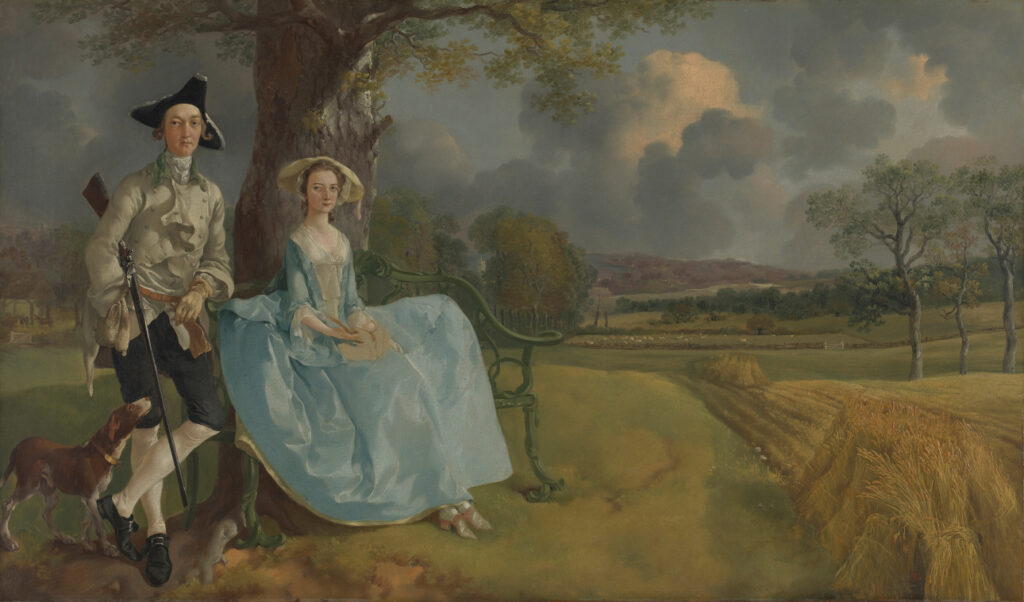
In the England of the late 1700s, the Industrial Revolution and colonial expansion created such a class as well. And this is what Thomas Gainsborough (1727-1788) portrayed in his famous, early canvas titled Mr. and Mrs. Andrews. Painted at the height of the Industrial Revolution, it shows a couple at their countryside estate. In fact, it shows them shifted to the side to better expose the rolling pastures and trees of their 3000 acres behind them. He is perched nonchalantly next to a bench, a hunting rifle under his arm and his game dog lolling about as if they had just walked up the hill from a morning pheasant shoot. She is seated ramrod straight, dressed in a silk gown and slippers, which are completely unsuited to running about in the hills but are very good for showing off the lady’s affluence. He looks a perfect model of a country squire; she is modeling the lady-of-the-manor look, spoiled only by her tight-lipped expression of someone who is either mean-spirited or at least somewhat stuck-up. She looks like a textbook nouveau riche—all money but little class. The painting is unfinished—perhaps the artist left room for painting in a baby when the couple had one, or perhaps it was a place to show off a game bird from Mr. Andrews’s hunt. The picture was delivered by the artist, and it stayed in the family until the 1960s, but not much on display. Perhaps Mrs. Andrews didn’t like the way she looked in this picture, especially given that in later paintings, Gainsborough would portray even courtesans and actresses looking glamorous and sweet-faced, something that he did not offer to Mrs. Andrews.
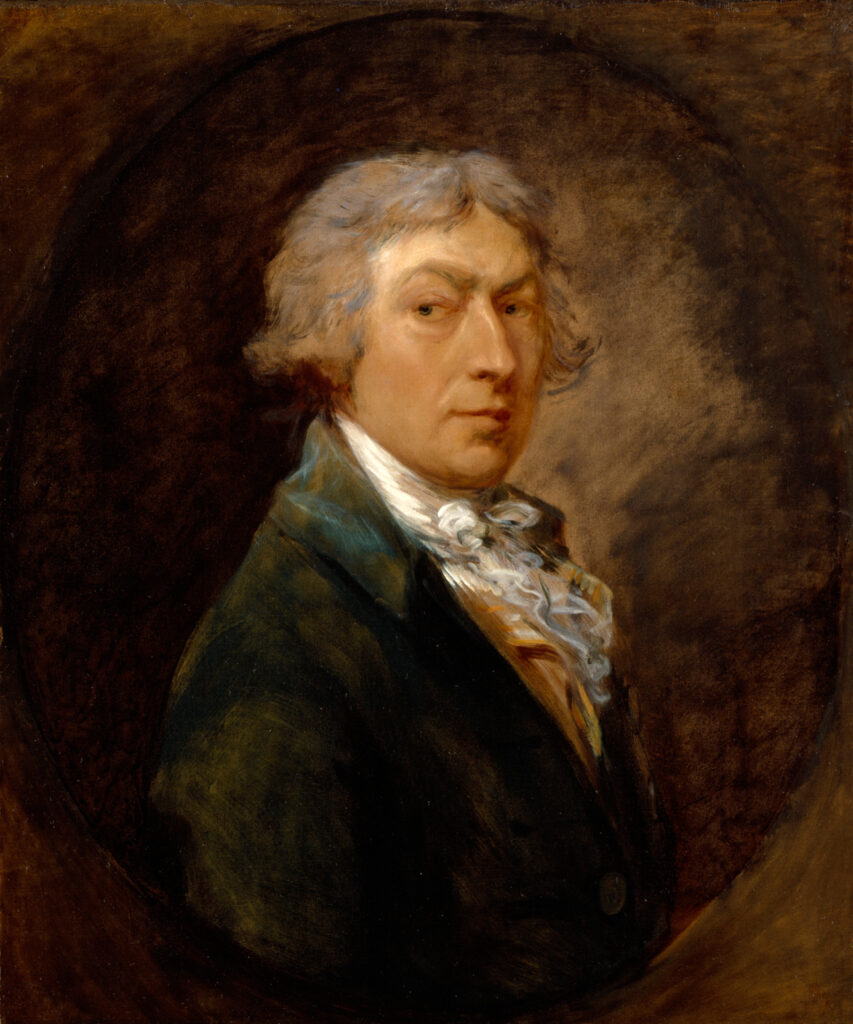
Gainsborough is the subject of a new exhibition in the recently refurbished Frick museum. Titled Gainsborough: The Fashion of Portraiture, the exhibition brings together various well-known examples of the artist’s bread-and-butter activity of portraying the rich and famous, looking their best in sophisticated clothing. Because his father was a trader in luxury fabrics, the artist was very attuned to the subtleties of the silks, laces, and muslins gracing his illustrious models.
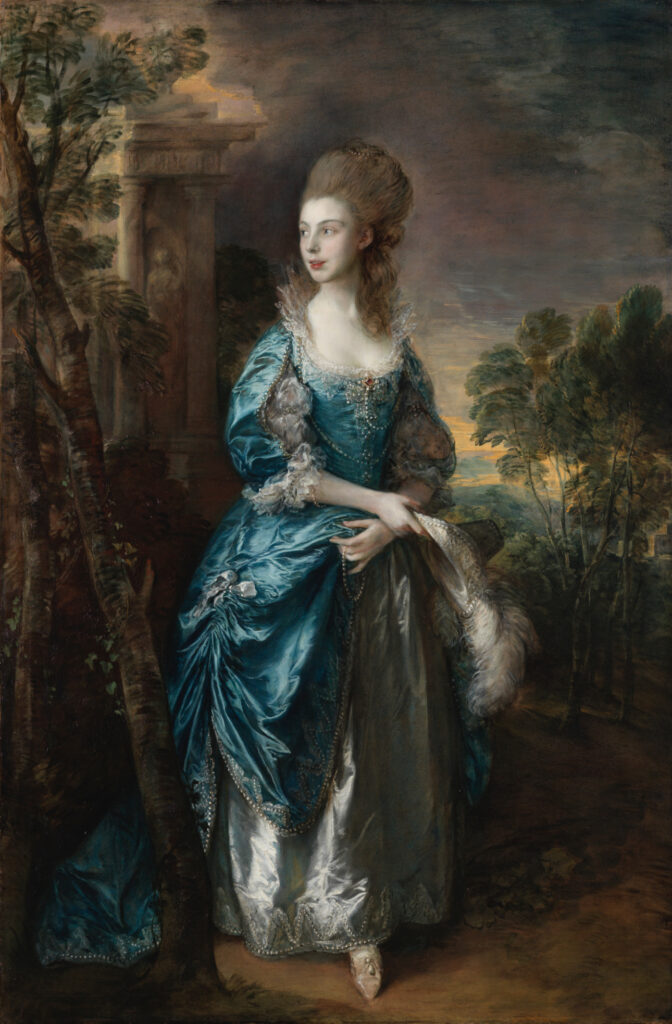
Gainsborough’s facility with making his female models shine in the latest frippery, rendered down to the smallest detail of lace and tulle, served him so well that he was constantly busy portraying young women in his titled clients’ households. One of them was Frances Duncombe, a 19-year-old whose serene pose and elegant attire cannot hide the look of unexpected defiance on her youthful face. The artist painted her in a classic pose of van Dyck’s court portraits, looking resplendent in folds of blue and silver silks. Her dress may even have been fictional, that is, a costume rather than an actual piece of clothing. Gainsborough’s sister Mary Gibbon had a haberdashery store downstairs in the house he rented in Bath. If you examine various portraits, some elements—dresses, laces, and hats—repeat. He would sometimes drape his models in costumes that he deemed more painterly than their own fashion choices. Come to think of it, John Singer Sargent did the same 100 years later, when he demanded that his titled models change into colors and styles he considered better for their portraits.
Back to young Ms. Duncombe…. Most interesting is the face of this woman. Orphaned young, she was raised in the family of her stepmother, brought up as a daughter of an illustrious aristocratic family but deprived of her mother’s support and guidance. As soon as she reached the age of consent, Elizabeth insisted on marrying an unsuitable man and fled with him to the continent to avoid her family, which was critical of this match. The marriage soon fell apart when the spendthrift husband acquired debts and then went back to England. Frances continued to live in Germany at the court of Maximilian Franz, the Cologne elector and a brother of Queen Marie Antoinette. Around the time of the French queen’s execution, Frances hastily returned to England. The portrait perfectly captures her youthful naiveté mixed with defiance, both traits that must have landed her in her disastrous early marriage and tumultuous travels.
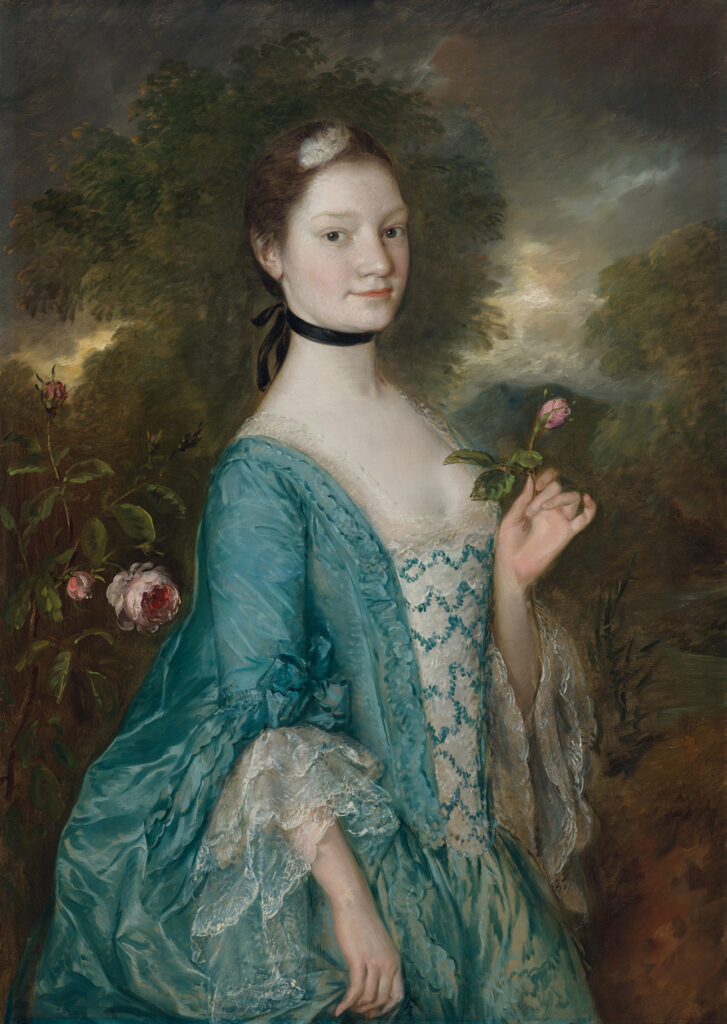
At the exhibition, there are two portraits of women holding a rose. The first is a girl of about 20, at the height of her beauty, painted in the style of formal van Dyck portraits that Gainsborough admired, copied, and referenced in numerous works. Early in his career as a fashionable society portraitist, Gainsborough worked in Bath, a spa town for visiting aristocrats and affluent city burghers, all of them “taking the cure.” From that period comes Sarah Hodges, Later Lady Innes, a three-quarters portrait of a young woman holding a rosebud, a symbol of her blossoming youth, while an opening rosebud on a bush nearby suggests the future promise of maturity. A black velvet ribbon underscores the paleness of her skin, and she looks on with the confidence of her youth and status as an heiress. She is a classic “English rose.”
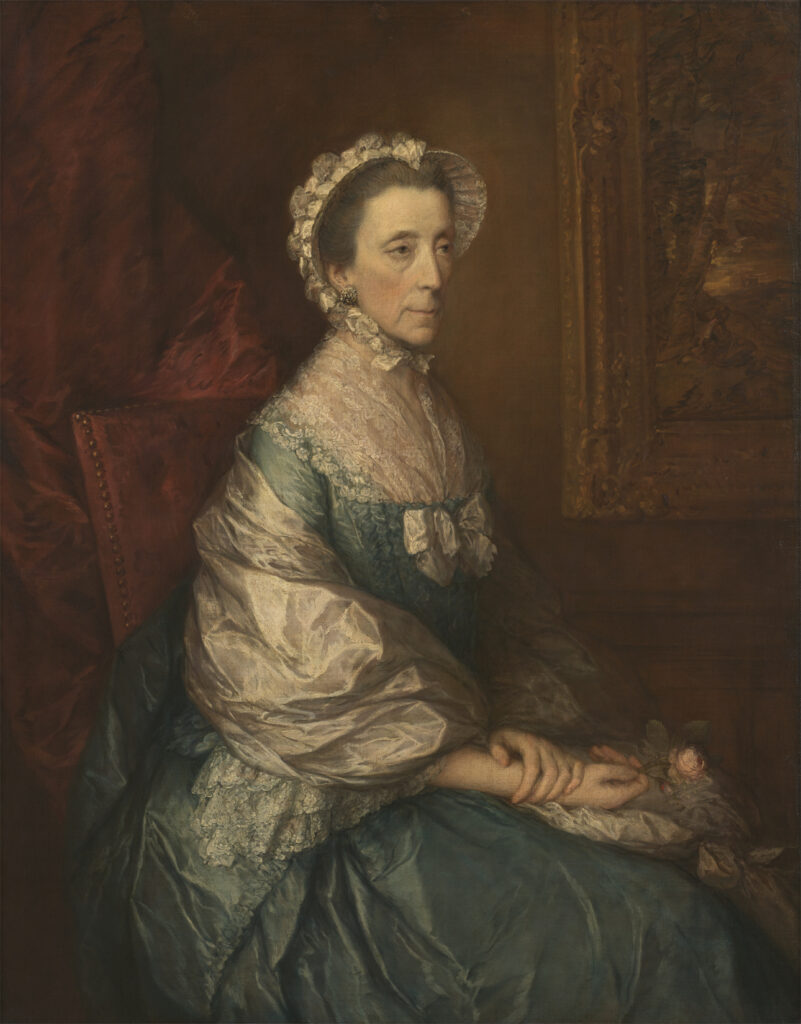
The other portrait with a rosebud is Mary, the Duchess of Montagu. The lady was 57 years old when Gainsborough painted her, and though she also holds a rosebud, it is laid in her lap instead of being coquettishly raised like in the other picture. She is dressed most sumptuously in a silk gown à la française, voluminous lace over her sleeves (called engagéantes), and her diamond cluster earrings feature hundreds of stones. The artist is not denying her maturity (which at the time would have been considered old age), but he has smoothed her face of wrinkles except some lines around the mouth. The duchess was a fan of Anthony van Dyck’s art (she had several of his works in the family collection), and both the rose and the dress allude to the Dutch master who Gainsborough admired and referenced all his life.
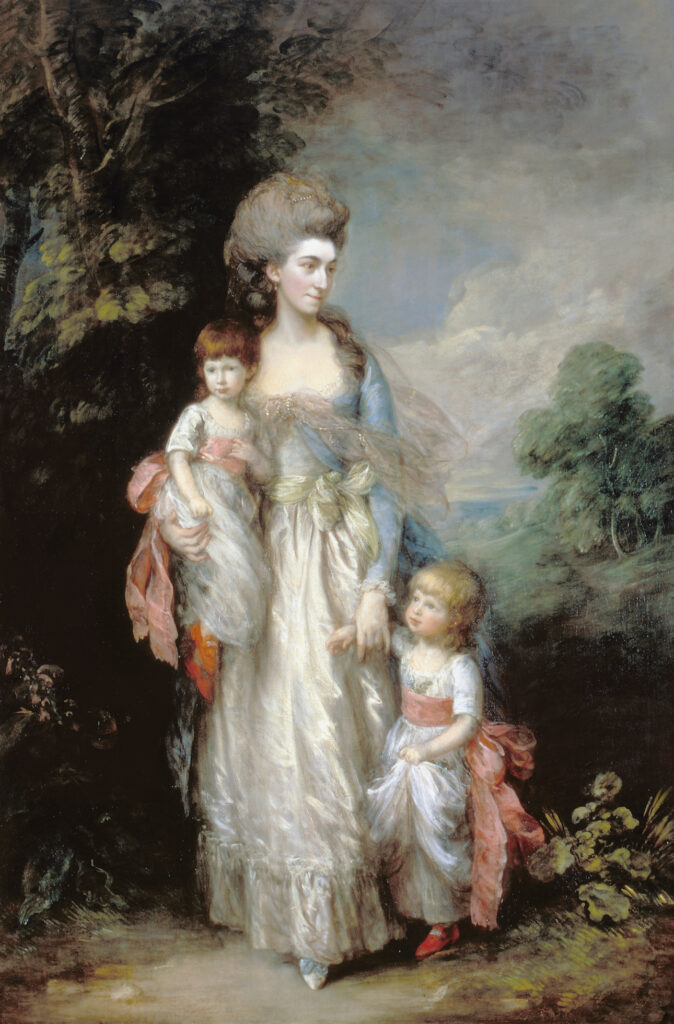
Beautifully painted, Mrs. Samuel Moody and Her Sons is ostensibly a portrait of a happy mother with two boys (they look like girls because in those days young lads would be dressed in dresses and scarves the same way as girls until they reached about seven years of age). Originally, Gainsborough painted Elizabeth Moody at the time of her marriage in a typical salon portrait of just her alone. However, she died of consumption shortly after giving birth to her second son. Her husband asked Gainsborough to rework the picture by including the two boys in the picture, who by then were toddlers. A wedding portrait of a fashionable lady was thus transformed in a memorial image of a mother gathering about her children, done as a memento for the sons who would not have had any memory of their mother at all.
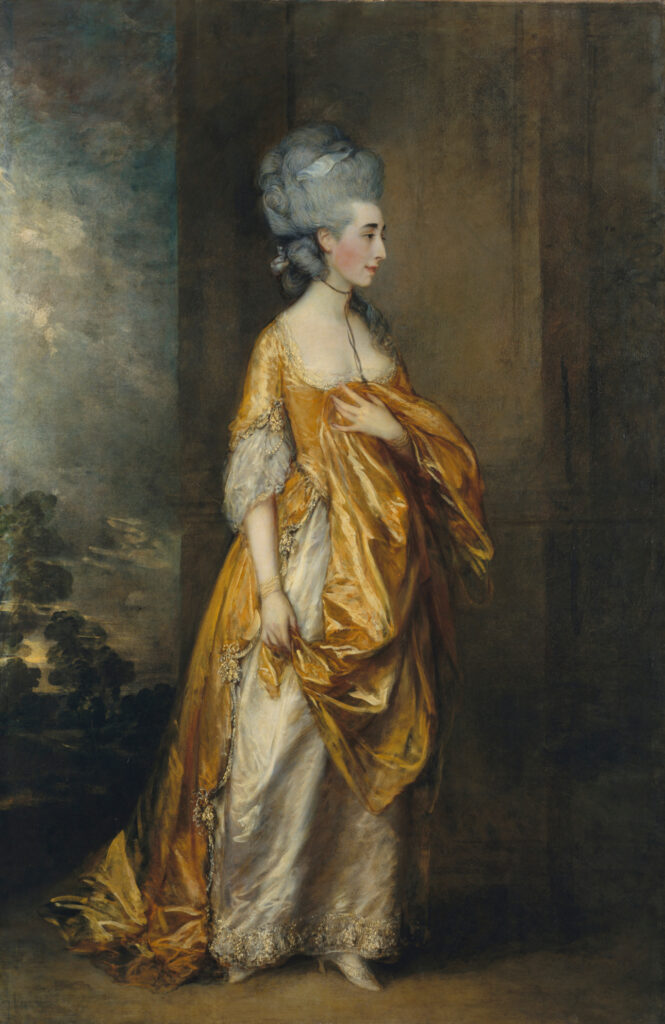
And old salesman’s adage is “We don’t smell ’em, we just sell ’em.” Gainsborough was a good salesman and would paint to order despite any social anathemas. Grace Dalrymple Elliott was just such a socially awkward model, but he made her look very respectable in an elegant yellow gown. She is also gathering the folds of this vibrantly colored silk toward her chest—a gesture of modesty that was slightly at odds with her reputation. Mrs. Elliott got divorced by her husband after an affair with Lord Valencia, followed by another high-profile liaison with the Earl of Cholmondeley, who likely commissioned this portrait. This painting was submitted to the Royal Academy at the height of Mrs. Elliott’s divorce, and her infamy added piquancy to the presentation of the picture.
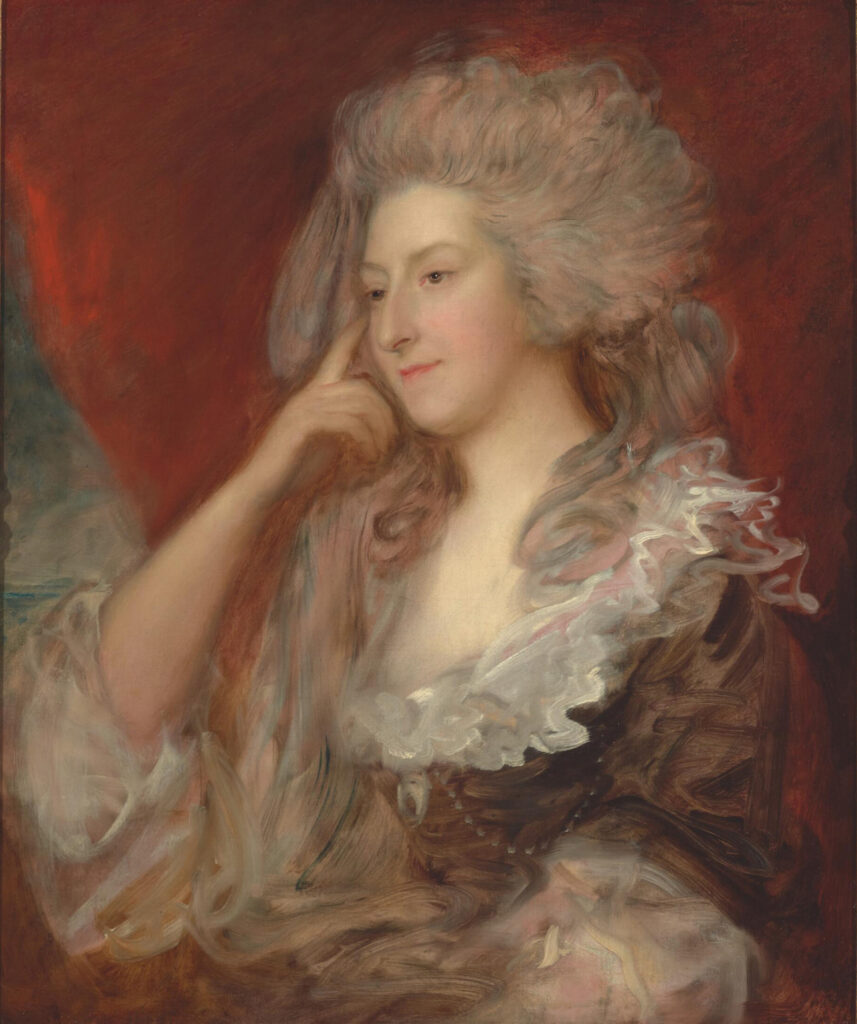
Even more scandalous was the person of Mrs. Fitzherbert—a secret wife of King George IV. She was a secret spouse with unrecognized children because she was a Catholic, and English law forbade royal princes from ascending to the throne if they were wed to a Catholic. In consequence, the Prince of Wales—the future king—married Mrs. Fitzherbert in secret, and she was never acknowledged even though everyone at court was aware of her status. Gainsborough painted two pictures of her (presumably as a royal commission), a full-figure salon picture and this smaller one, perhaps intended for the private apartments. While the face is rendered in detail of skin tones and expression, the frippery of lace collar and silk fabric are done in almost Impressionist slashes. This is an unfinished work, but thanks to this, the portrait looks liberated and intimate, much different from the formal posed pictures above.
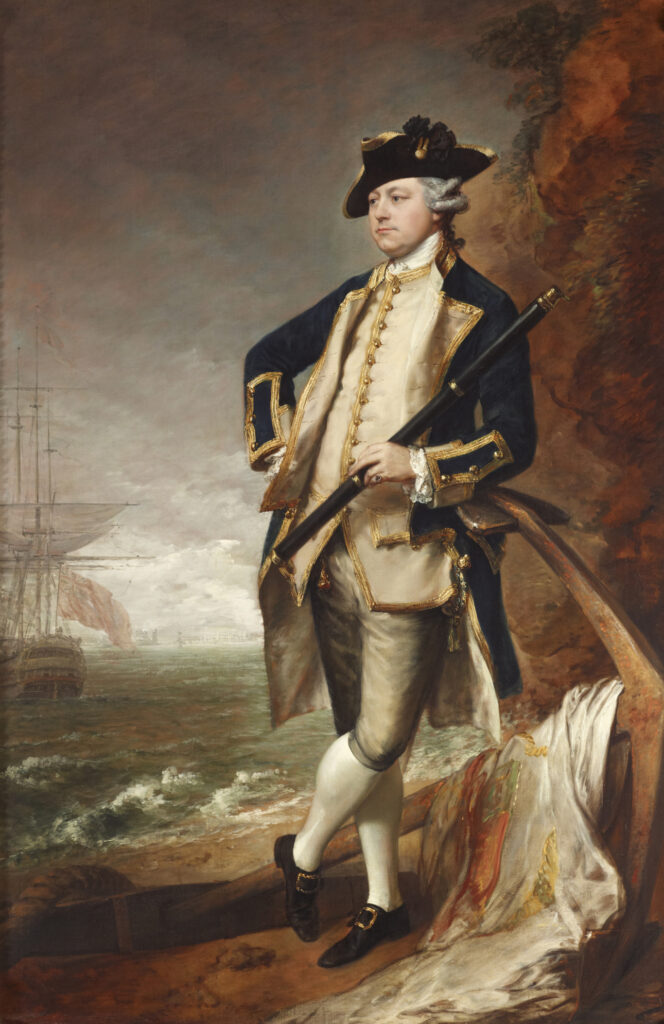
Gainsborough did not only paint society ladies. Many of his commissions were portraits of men—landowners, politicians, rich merchants. Even though convention required that the model be posed in a classical stance and full regalia, he would enliven the compositions as much as he could. In his portrait of Captain Augustus John Hervey, for example, he painted behind the suitably imposing figure a ship and a harbor view of Havana (the naval officer took part in the battle of Havana in 1762, during the Seven Years War).
Gainsborough painted aristocrats because this was his job, but he also painted his friends, especially those connected to music, because being a musician was his private passion (even though the consensus was that he should stick to painting). With his friends, he would exchange his artwork for music lessons. An example of such a friendship exchange is one of the most brilliant portraits he made, of musician Carl Friedrich Abel.
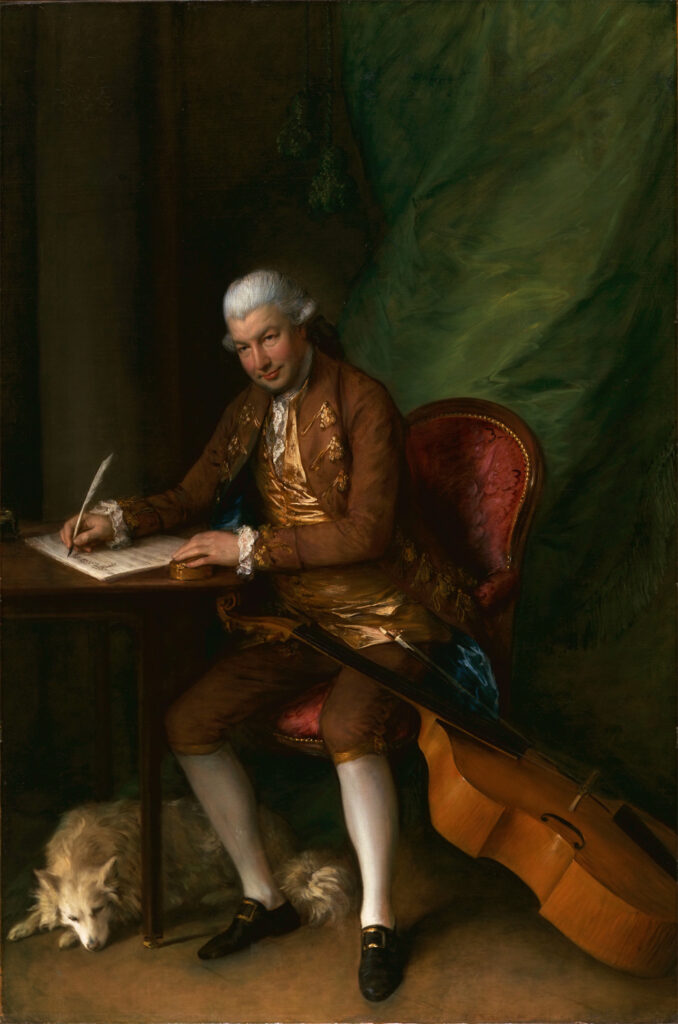
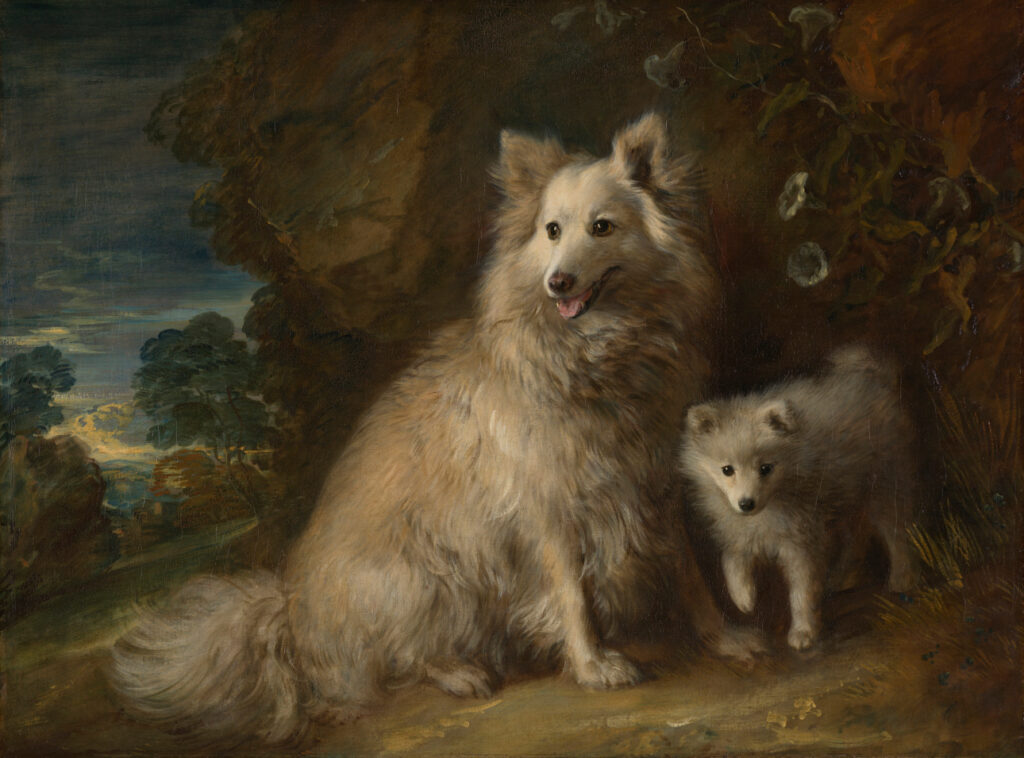
Abel arrived in England from Germany with Johann Christian Bach (the youngest son of JSB)—they both were chamber musicians and composers at the court of Queen Charlotte. Abel was one of Gainsborough’s closest friends, providing him with instruments and music lessons in exchange for paintings. He is portrayed with the attributes of his work and life: his viola da gamba (a precursor of the cello) on his knee, his hand resting on a gold snuffbox, which was a present from the king of Prussia, and accompanied by his Pomeranian dog, a breed rare in England, imported from Prussia. A flat photo reproduction can hardly give justice to the actual painting, so incredibly well done with the gold accents of the livery’s passementerie, the glint of chair nails and the snuffbox, and the gold thread of the waistcoat—all rendered with flicks of yellow paint that from a distance glitter like true gold. In real life, Abel struggled financially, but this is a portrait worthy of an English lord, with no hint of any monetary struggle. Gainsborough’s painterly magic could transform an impoverished musician into a wealthy aristo, and a dead woman into a happy mother of growing children. He could even paint an exquisite pet picture, as evidenced by a portrait of Abel’s Pomeranian with her small puppy.
Among Gainsborough’s formal portraits of sea captains, landed gentry, aristocratic debutantes, and duchesses who patronized his art, there are pictures that he did not necessarily as commissions but because he was interested in the subject. Such a portrait could be one of Ignatius Sancho, who was an actor, a composer, and the first and only 18th-century black man who voted in the British parliament. At the time of this portrait, Sancho was in service to the Duchess of Montagu, but he is not shown wearing the household butler livery. Instead he is dressed as a gentleman, looking as distinguished as any other client of the portraitist to the rich and famous.
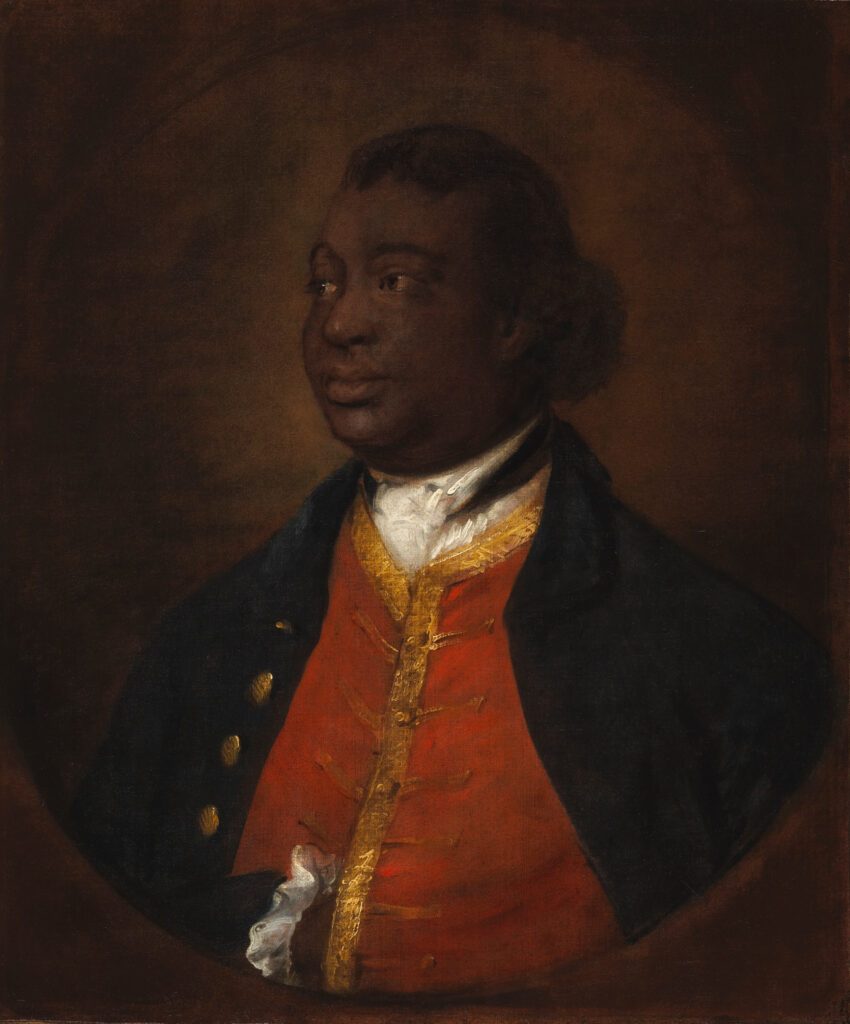
It is not clear if this was a commission (there is no trace of a fee payment). Quite possibly, the artist may have just wanted to paint an interesting person. We know he was tired of doing formal portraits because he confessed once that he was weary of the “cu’sed face business.” So maybe this excellent portrait is an example of an artist’s freedom from daily chores.
When museumgoers are surrounded by the visual assaults of contemporary art displays, from the sexual frankness of Tracey Emin and Alice Neel to the garishness of pop art by anyone from Jeff Koons to Takashi Murakami, it is refreshing to see something less in-your-face, more reliant on actual painting skill and delving into the human psyche in the most subtle ways.
Wisely curated and beautifully displayed, the exhibition Gainsborough: The Fashion of Portraiture runs from February 12 to May 25, 2026 at the Frick Collection in New York.