
Food for the Soul: Renoir and Love
By Nina Heyn
Imagine that it is 1871 in Paris. The city, and in fact the whole country, are recovering from a brutal Franco-Prussian war as well as a revolt of Communards that has destroyed many Paris streets and buildings. In the art world, the paintings considered most prestigious are historical and mythological tableaux that depict violence—battles, conflicts, rapes of nymphs, abductions of women, mutilations of men. Real people in the streets are not faring well either—the post-war poverty is forcing young women into prostitution, children into begging, and men into backbreaking labor. Life in Paris is portrayed by Degas in pictures of laundresses yawning from exhaustion and by Toulouse-Lautrec in portraits of cabaret singers and street alcoholics, while Courbet is painting peasants toiling in the fields.
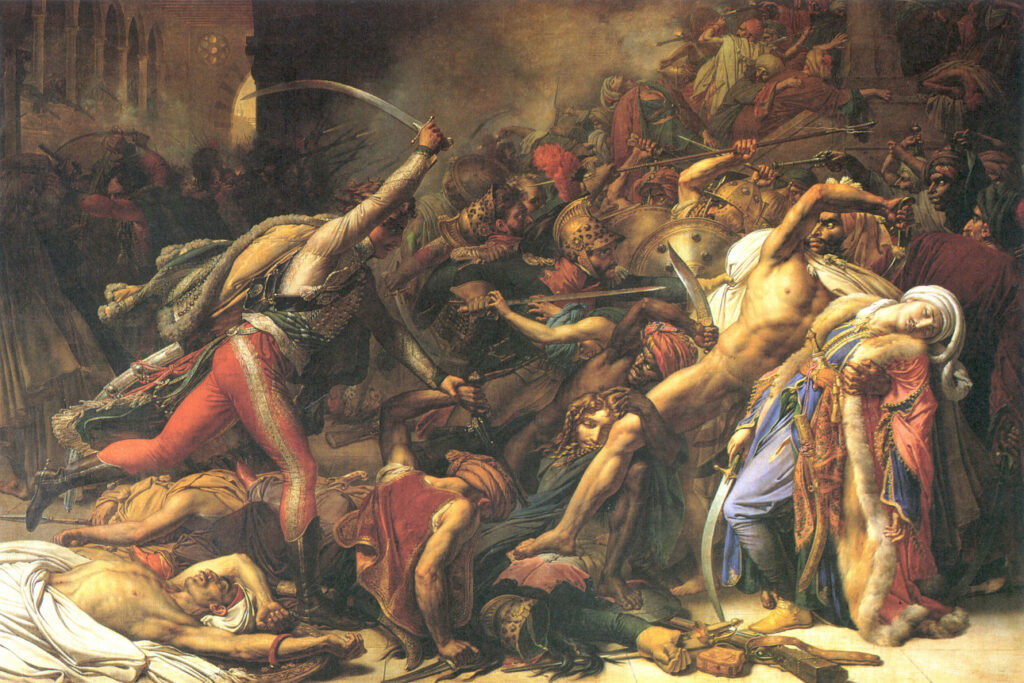
Into this world of real hardship and academic art violence comes Pierre-Auguste Renoir, a young artist who has a different point of view.
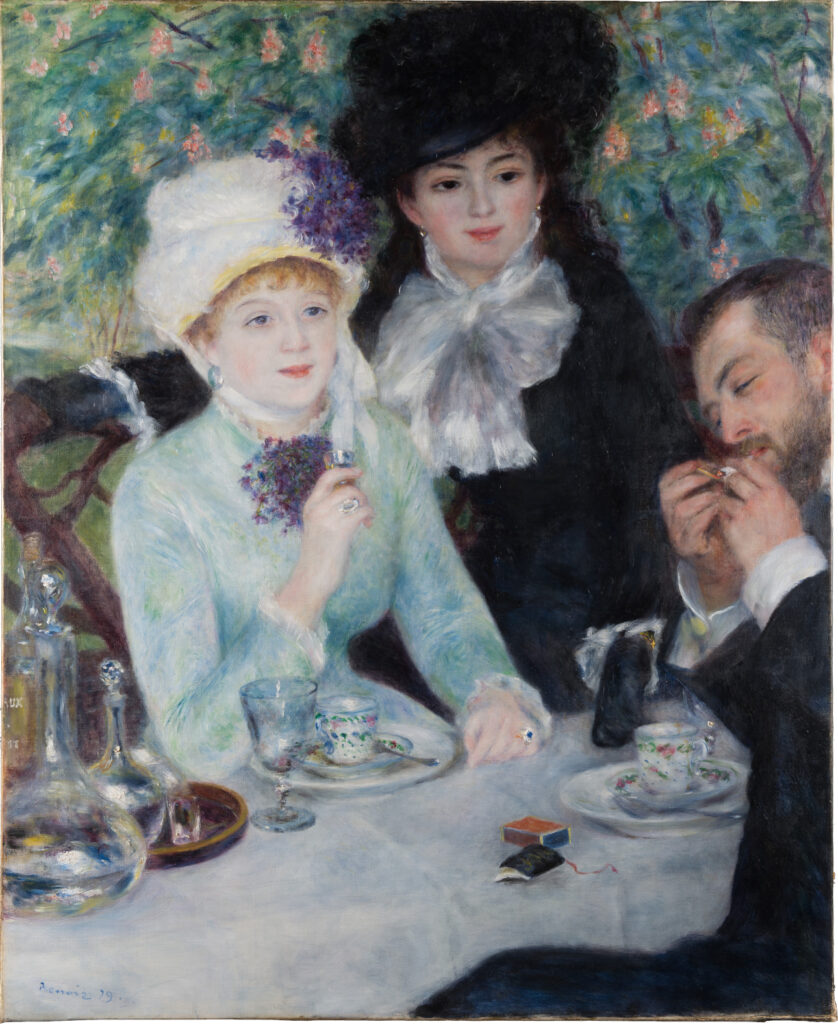
The Musée d’Orsay exhibition Renoir and Love: A Joyful Modernity 1865-1885 highlights his deliberate choice of themes and style to show happiness, positive relationships between people, and beauty in nature—all the things that were in short supply in daily life in the Paris of the 1870s. The exhibition highlights this aspect of Renoir’s artistic credo through an impressive array of paintings from his strongest early period between roughly 1865-1885.
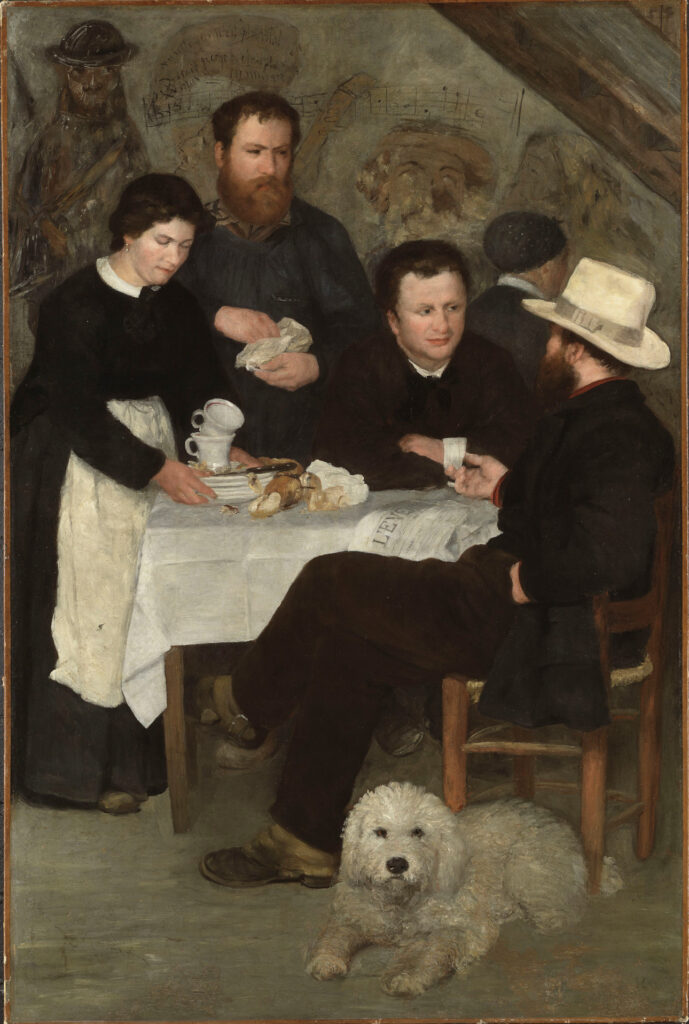
One of his earliest paintings to show strong and friendly relationships is Mother Anthony’s Tavern (Le Cabaret de la Mère Anthony). It shows three men at a table after a meal, talking and engaging with each other through gestures and regards. The style of painting was still an academic one, but the choice to show people in harmonious interaction was already a significant clue as to the artist’s preferences.
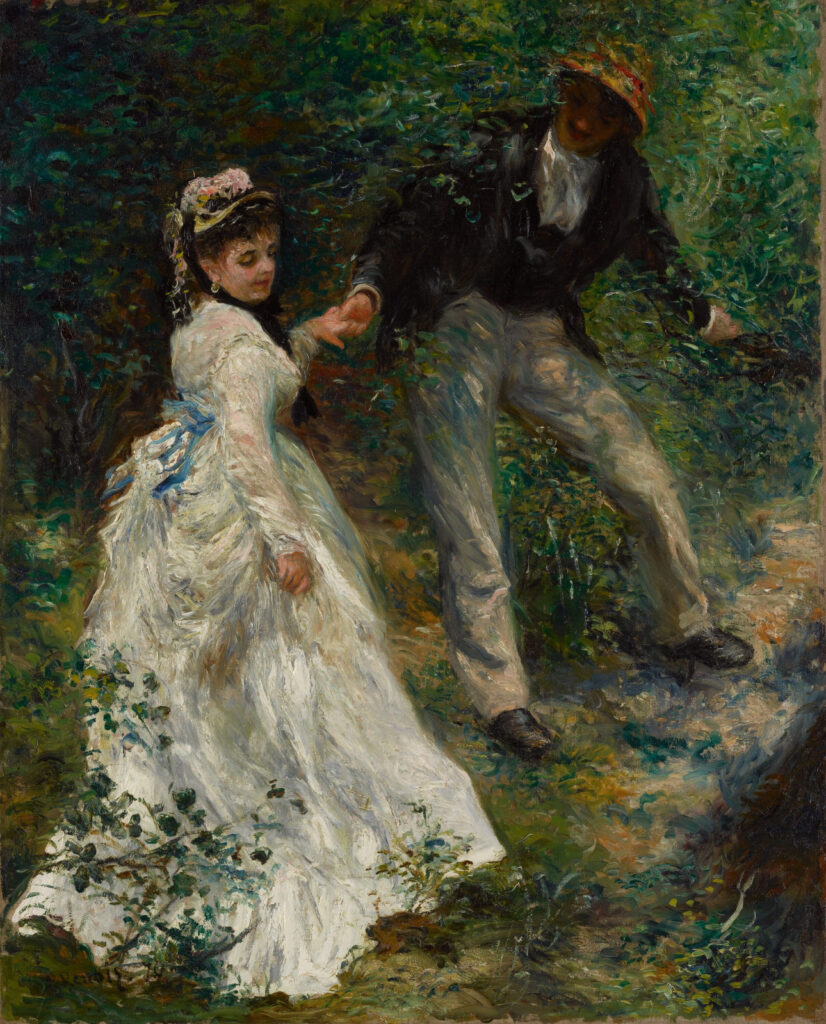
Both the thematic approach and the new style would soon come together in The Walk (La Promenade), painted just a few years later in 1870. It shows a happy couple on a walk in a park where a small slope suddenly presents an opportunity to flirt a little. This painting also shows a new type of Parisian from the working classes: women who would go for a walk without a chaperone and men who would have the time and inclination to enjoy the city park. Renoir himself came from the same working class, and through his pictures he became a chronicler of the new Paris—a city in architectural and social transformation. Paris entering the last decade of the 19th century would become the subject of Renoir’s twenty years of painting, capturing city scenes at dance halls, boating docks, and river restaurants. He painted all of this in the new style of stippling brushwork and the use of outdoor light. In 1874, this style would gain the name of Impressionism.
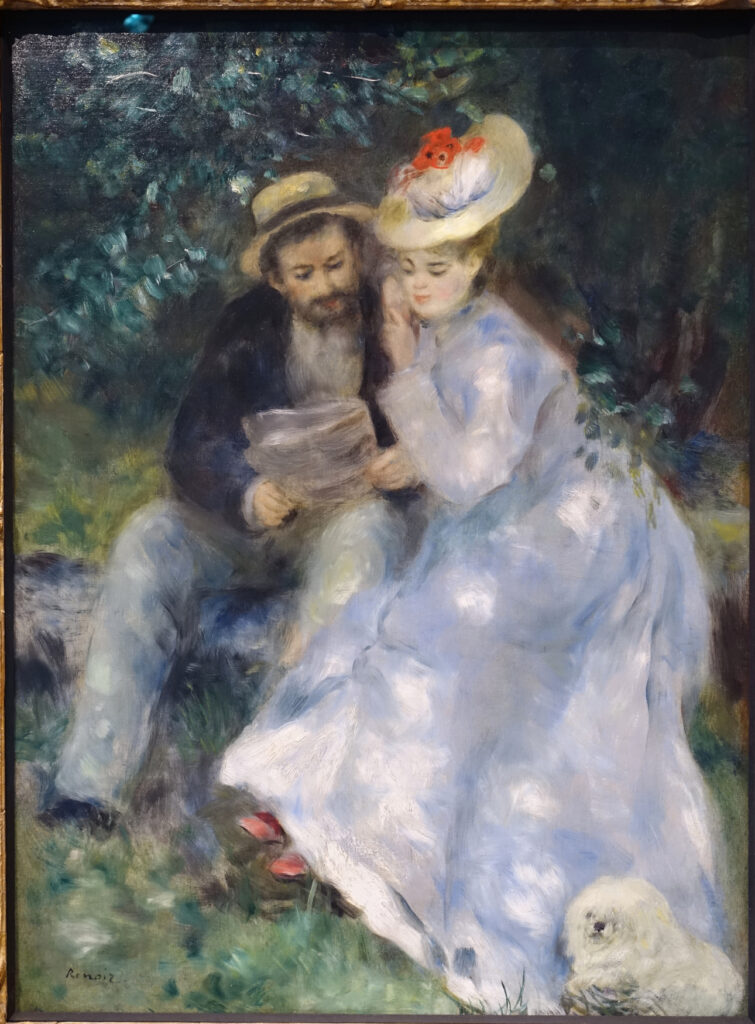
Confidences. The Arbor (Confidences. La Tonelle) is an intimate picture of a couple totally engrossed in whatever they are reading together. He is reading aloud, while she is snuggling close to him on the pretext that she needs a better view of what he is reading. In this scene, there is no grandstanding of a historical drama, none of the poverty and toil of Courbet’s peasant portraits, and no hint of the recent war and revolution. There is only a happy togetherness. The patches of sunlight on the woman’s dress only underscore this romantic feeling.
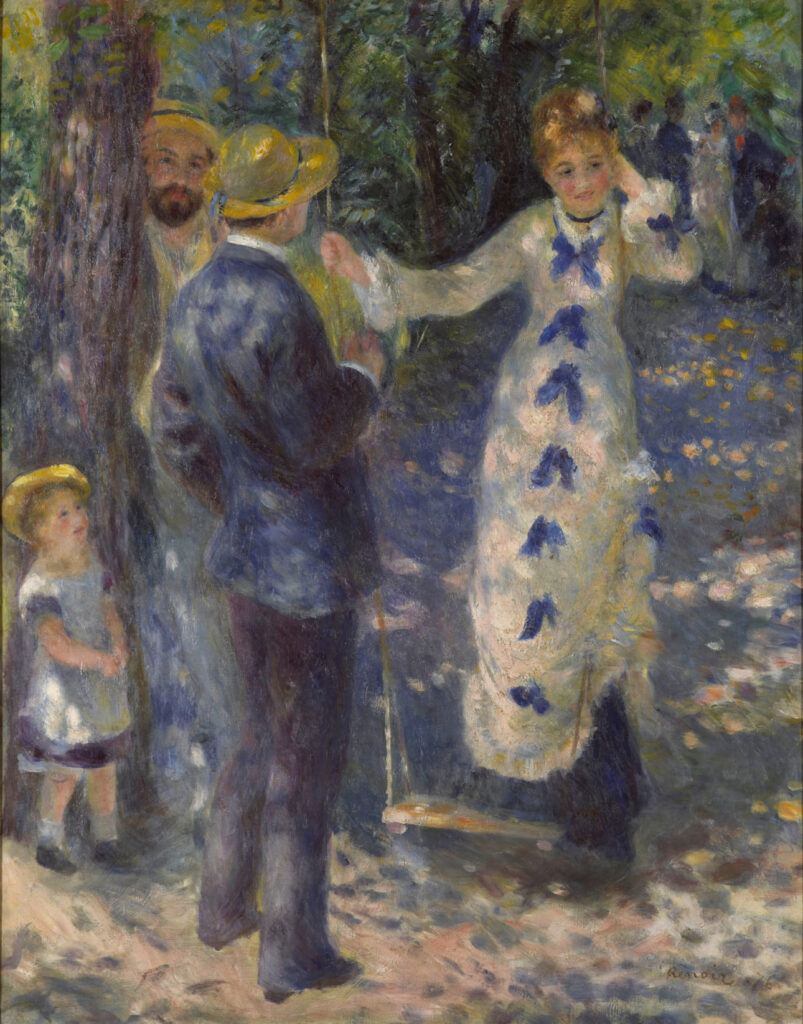
Sometimes the relationships portrayed by Renoir in his scenes of Parisian life would be a bit ambiguous, as in The Swing (La Balançoire).
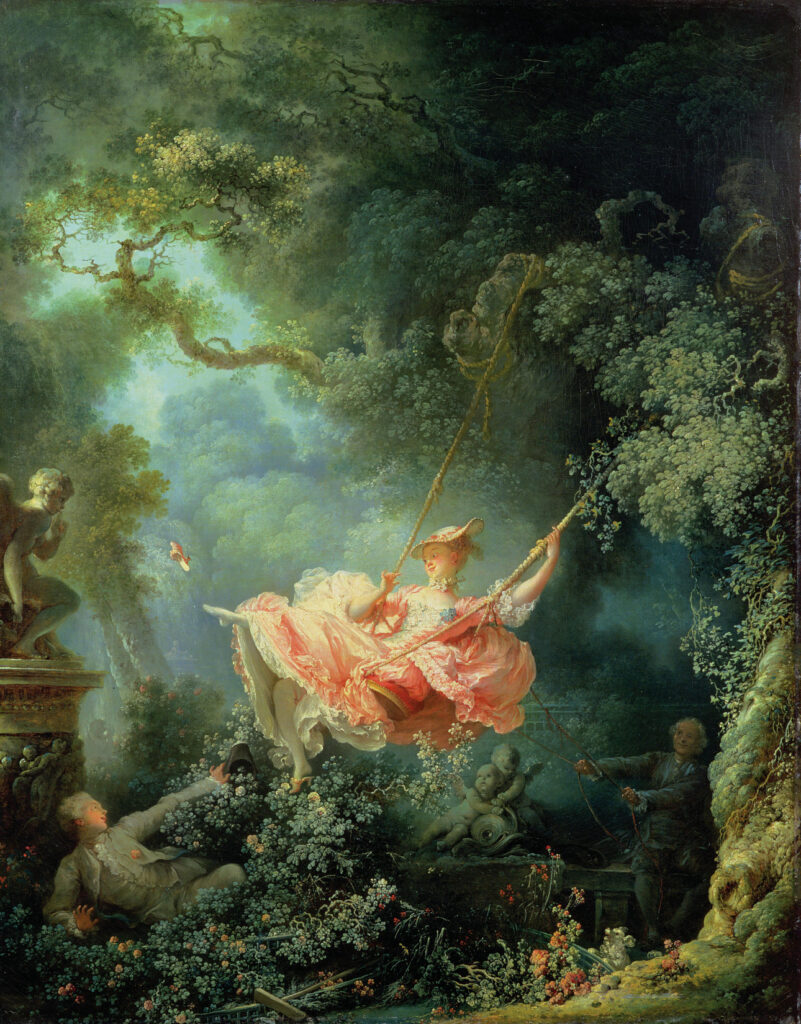
Evoking the famous painting by Fragonard, an artist whom Renoir admired as much as all other Rococo masters, this is a scene of an innocent flirt but … perhaps it isn’t. In the Montmartre hills where Renoir had his studio, he could often witness the solicitations of “working girls.” The woman could be one of those girls, except that she is looking away, so perhaps she is reluctant to have a relationship with either of the men? Is the small girl looking up at this trio her daughter? Is the swing hinting at the woman’s indecision? Is it a simple chat in a park, or is this the beginning of a monetary transaction? In any case, even if this is indeed a scene portraying the freewheeling life at Montmartre, the mood is not depressing as it would be in Toulouse-Lautrec’s images of the same Parisian streetwalkers. In Renoir’s world, there is always light, and instead of hinting at immorality, the swing and the child bring in an atmosphere of play. Incidentally, this tree and the swing still exist in place at the house that Renoir occupied when he staged models for this scene. You can visit the garden and see the swing—they are now part of the Montmartre Museum.
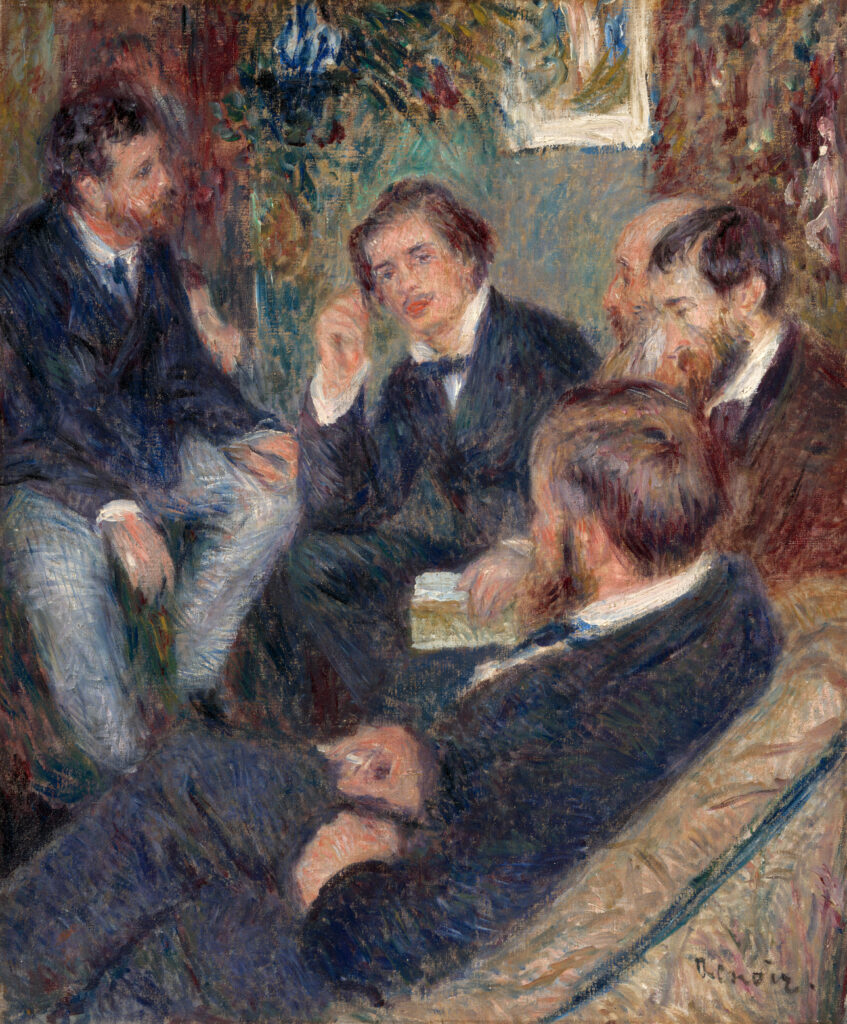
Renoir did not paint only women in gardens and happy couples dancing. He was a very active member of the new Impressionist movement, planning independent exhibitions and discussing new literature, art styles, and politics with fellow artists. The painting At Renoir’s Home, Rue Saint-Georges (Chez Renoir, rue Saint-Georges) portrays his friends gathered in an evening at his new apartment-studio at 35, rue Saint-Georges, where he lived between 1873-1883 (that is, during his most fertile Impressionist decade). The man on the very left is Camille Pissarro, who was older than Renoir, Monet, and other Impressionists but who became their friend and mentor. The mood is perhaps serious but convivial—these are friends and collaborators in the task of creating new art. Where Berthe Morisot would find melancholy and Degas would cast a critical eye, Renoir would only find relaxed companionship.
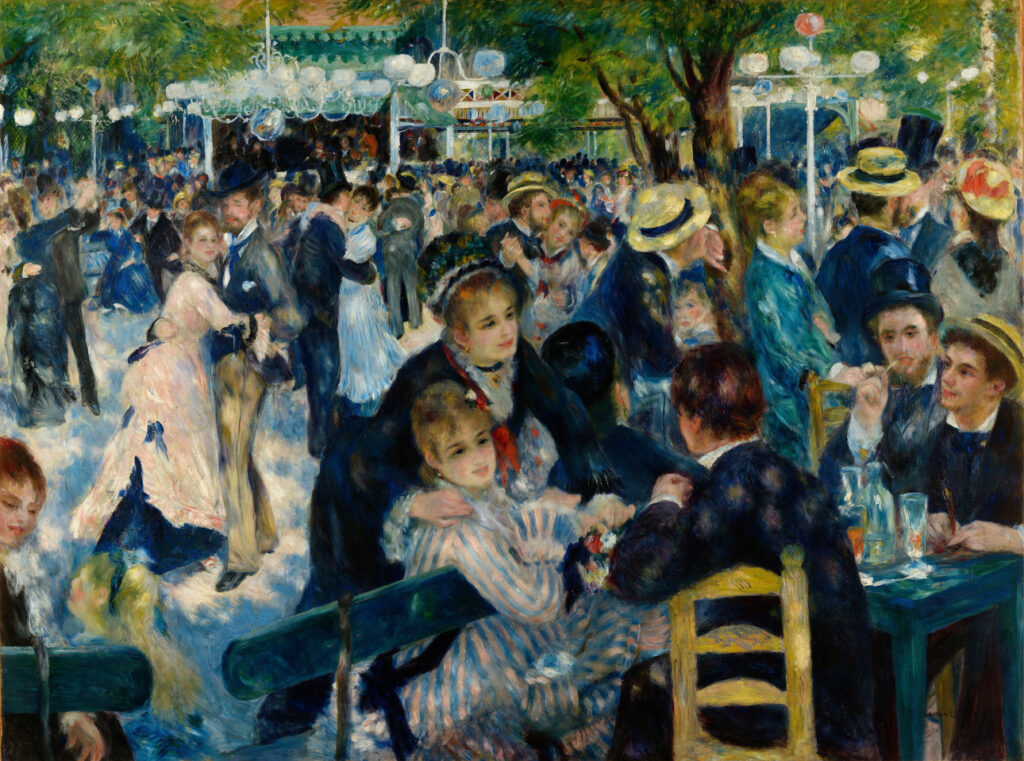
The exhibition reunites two Renoir group pictures, probably the most famous, that have served as icons of Impressionism for over 150 years. The first, titled The Bal at Moulin de la Galette (Le Bal du Moulin de la Galette) is the star of the Musée d’Orsay collection; the second, Luncheon of the Boating Party (Le Déjeuner des Canotiers), has been exceptionally brought to Paris from the Phillips Collection in Washington. The Bal is a celebration of post-war Paris—young women and men who came to the city in search of work are enjoying an evening with music and laughter, dancing with abandon at an open-air entertainment hall. This celebration of a simple afternoon dance is extremely far removed from the academic pictures of Greek heroes and warriors that would have been the staple of Paris museums and galleries at the time. It celebrates the joie de vivre of the working class from which Renoir had issued and which was less often portrayed than aristocrats at the opera and society ladies at formal balls and receptions—the favorite subject matter of society painters such as James Tissot or William-Adolphe Bouguereau.
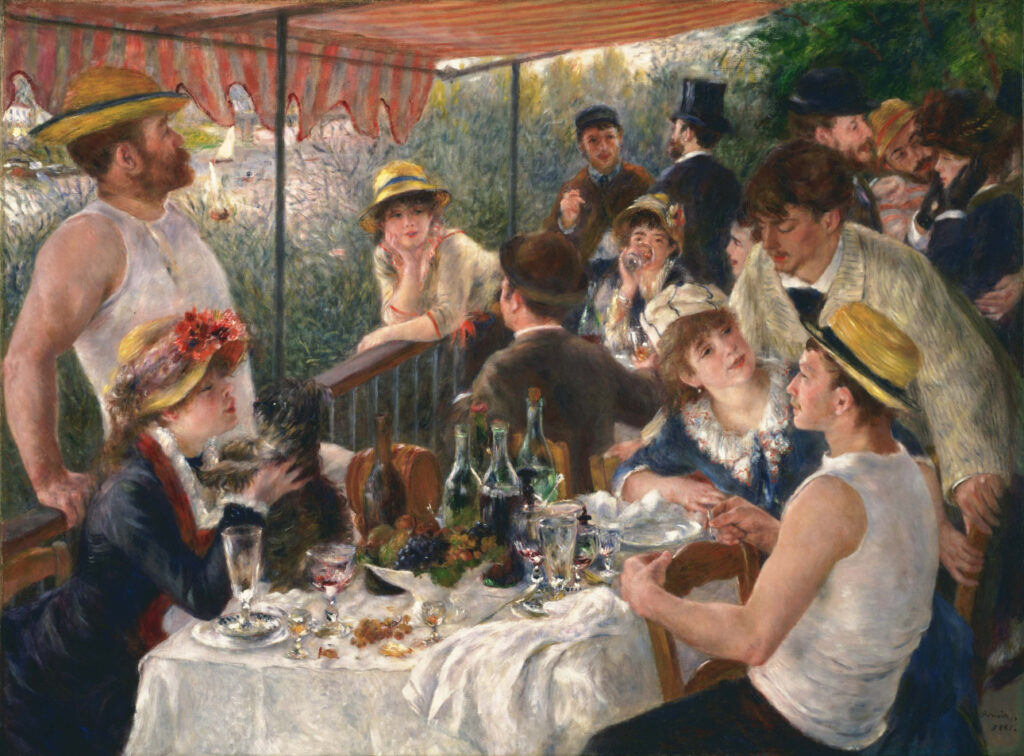
Renoir’s ultimate tour-de-force of composition and his mastery in showing relationships is Luncheon, which arranges 14 people (and a dog) interacting after a leisurely meal. They are chatting, flirting, looking at each other, or doing just the opposite (ignoring someone). This grand canvas is Renoir’s artistic credo, with the artist reaching back to Rococo’s fêtes galantes and establishing his own legacy of a masterful composition, an Impressionist approach to color and light, and a devotion to a theme of modernity: documenting the lives of ordinary people.
In both of these incredible paintings, Renoir is creating relationships between figures through the direction of their gazes, the tilts of their heads, a hand placed on a shoulder, or through body language and a smile or an averted look.
Thanks to the legacies of such famous Parisian collectors as Gustave Caillebotte and Isaac de Camondo, d’Orsay has become a repository of some of the most iconic Renoir canvases from his pure Impressionist period. Coupled with significant loans from other collections, this new show can serve as a primer on both Renoir and the perennially popular art movement he represented. But it is also simply a feast for the eyes, a source of visual pleasure and happiness—exactly as Renoir intended when he declared that he wanted to paint “happy modernity.”
The exhibition is open at the Musée d’Orsay between March 17-July 19, 2026, then at the National Gallery in London between October 3, 2026- January 31, 2027, and finally at the Museum of Fine Art in Boston between February 20 and June 13, 2027.