
Food for the Soul: The Odyssey
By Nina Heyn
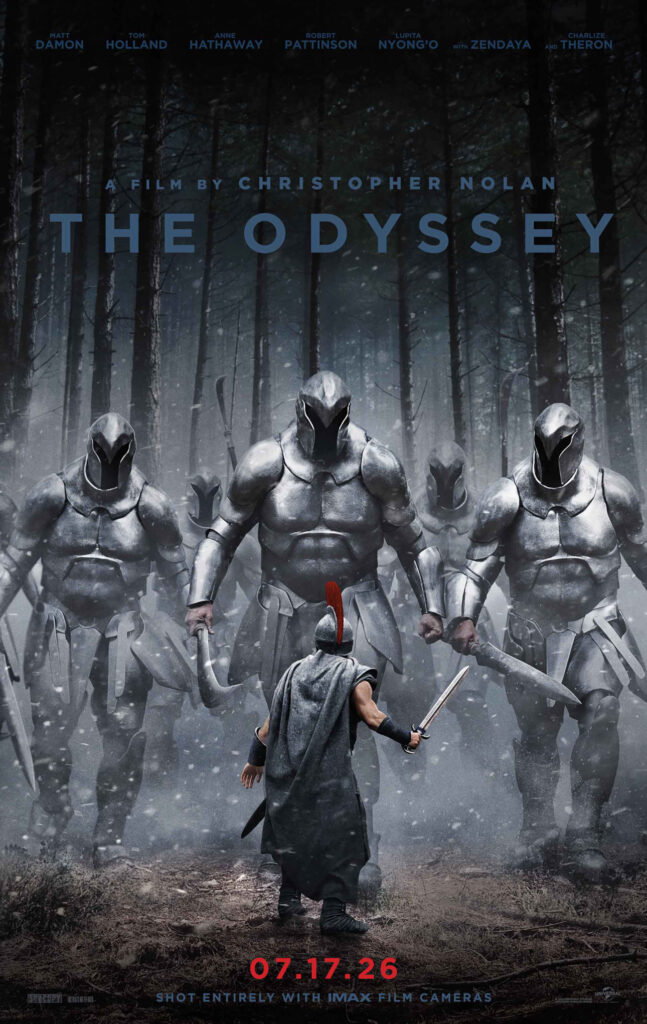
Director Christopher Nolan does not let his audiences down. Every few years, he makes that one “must-see” film of the year: The Dark Knight in 2008, Inception in 2010, Interstellar in 2014, Dunkirk in 2017, Oppenheimer in 2023. This year, his movie The Odyssey is such a film. Tickets to IMAX shows have been presold for a year, and theater seats are filled to the brim with viewers who vary in age, gender, ethnicity, and cultural tastes—this being a rarity in itself in the age of preferences individualized to the max. Nolan’s reputation, the studio’s marketing, and awareness of the title (even if few people actually have read the classic tale) have all driven people to theaters en masse.
All of this hype would have fizzled out after the first weekend if Nolan had not delivered… but of course he has, in spades. The movie will soon reach and then surpass Nolan’s record of $1 billion in box office grosses for some of his previous releases.
There will be some plot spoilers in what I write below, but considering that the book is 3,000 years old, they should not really be a surprise by now.
Nolan’s retelling of Homer’s epic, perhaps even more than the original, is a metaphor for the human condition (in the original sense of French philosophers’ la condition humaine). The encounter with the terrifying cyclops Polyphemus, the one-eyed giant, is about horrible accidents that happen in life—one minute you are fine, say exploring a cave or driving on a freeway, and the next you are confronted with a man-eater (in the case of Odysseus) or a big-rig truck that lost its brakes (in the case of our contemporary life). Horrible things happen to people sometimes, out of the blue.
When a band of Odysseus’s men—large, uncouth, and carrying swords—demand food from Circe and she turns them into swine, one should not be too outraged by her action. The sorceress stands for all the women at the mercy of men who demand things because they are stronger, armed, or more numerous.
Odysseus’s choices during his long wandering are also metaphors of life lessons: his vengeful firing of a parting shot at Polyphemus is a huge error of judgment; he will have on his conscience the sacrifice of some of his men as the only way to save the rest of the crew from a whirlpool; and he discovers that his curiosity about the seductive voices of sirens has led him to untold agony. Giving credence to flattery and false promises can easily lead to a downfall, say both Homer and Nolan.
Sometimes Odysseus is shown to have learned from his vicissitudes: his caution in approaching his palace after the long absence stands in contrast to Agamemnon’s triumphant return, which swiftly ends in the latter’s assassination because he failed to assess what awaited him at home. The encounters with the cyclops and Circe the sorceress have taught Odysseus to be wary when entering an abode, even if it is his own palace.
Toward the end of the movie, Odysseus is relating to Penelope the final breach of the gates of Troy after his Trojan horse trick got him and his crew inside the walled city. He tells her that he watched ten years of pent-up rage unleashed onto the Trojans by Agamemnon’s army. Odysseus is horrified at the destruction that his cunning trick unchained. Penelope consoles him with an optimistic “civilization will survive.” In the case of the actual Ithaca and other Mycenaean locations, this optimism may have been unwarranted, because the Sea Peoples arrived around 1175 BC, destroying this and other Mediterranean kingdoms. In the case of the 21st-century director who is witnessing modern conflicts and military threats, perhaps this is indeed an expression of hope.
Anyone who has ever seen castle ruins or some footage of any modern war is quite familiar with the never-ending cycle of war and destruction that characterizes human history. Homer wrote about the Trojan War in the 8th century BC. Nolan has made it into a film in the 21st century, but not much has changed in the intervening 3,000 years. His retelling brings in the images of an army conquering a city—relentless violence against both the defending soldiers and civilians, fire and destruction everywhere—all shown in IMAX scope, filmed with actual props and decorations rather than CGI, with an incredible cinematic inventiveness that makes it a spectacle drawing people back into cinemas. Whether or not it is causing them to reflect on the never-ending cycle of destruction that mankind unleashes onto itself is another matter.
The Odyssey is a vast cinematic tableau of overhead shots that show Odysseus and his crew against endless beaches and seas, rugged cliffs, and strange forests. The movie has everything: scary encounters with fantastic creatures, visceral combats with swords and battleaxes, hapless Penelope fending off boorish suitors, the pitifully inexperienced Telemachus who is not ready to be a man, and then Odysseus himself—a man whose cunning, bravery, and experience repeatedly prove useless against the will of the gods. This was true in Homer’s time and, according to Nolan, is also true in modern times—we are helpless against a fate that grants favors or tosses us about. This is what the original Odyssey is really about. John Lennon’s quote of a quote “Life is what happens to you when you are busy making other plans,” came true in his own tragic end, and it is true in any time and place. For Homer, this was a story of Odysseus unable to return home for a decade. For the rest of us over the centuries, the same inability to control our fate–whether the cause is accidents, war, illness, or the unexpected actions of others—is one of the fundamental truths of human life. Except that Nolan makes this truth incredibly visual, exciting, artistic, visceral, and entertaining. What more should one want from a movie?