
Food for the Soul: A Thanksgiving Feast
By Nina Heyn
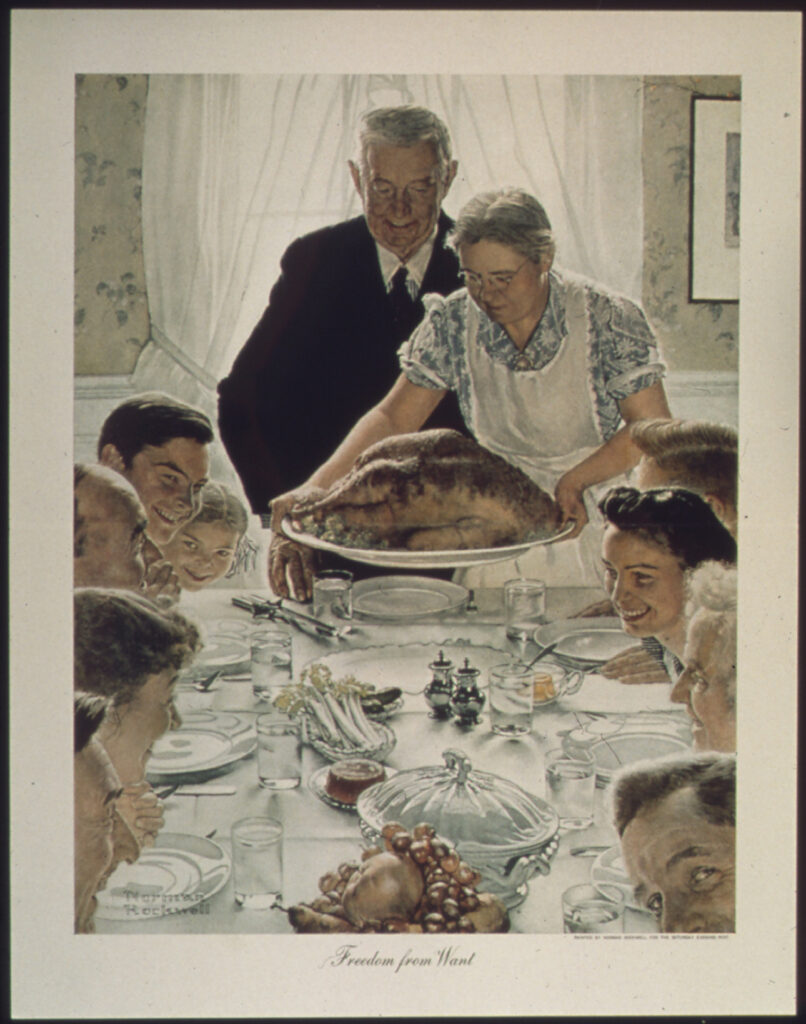
Traditional dishes for the Thanksgiving dinner vary between families and regions in the U.S., but there are some popular staples that are standard on holiday menus. Here are some of these Thanksgiving “musts” as they appear in various masterpieces of fine art.
POTATOES
Before Vincent van Gogh (1853-1890) discovered the south of France with its incredible bright sunlight and fields of sunflowers, he tried to be a pastor in Nuenen in his native Netherlands. This was a rural area where the local farmers cultivated a lot of potatoes that fed the rest of the country. The sun shone infrequently and never very bright, so the skies were grey and the landscape had equally subdued colors. Van Gogh failed to become a preacher, but he started becoming a painter, learning during that time to paint portraits and still lifes.
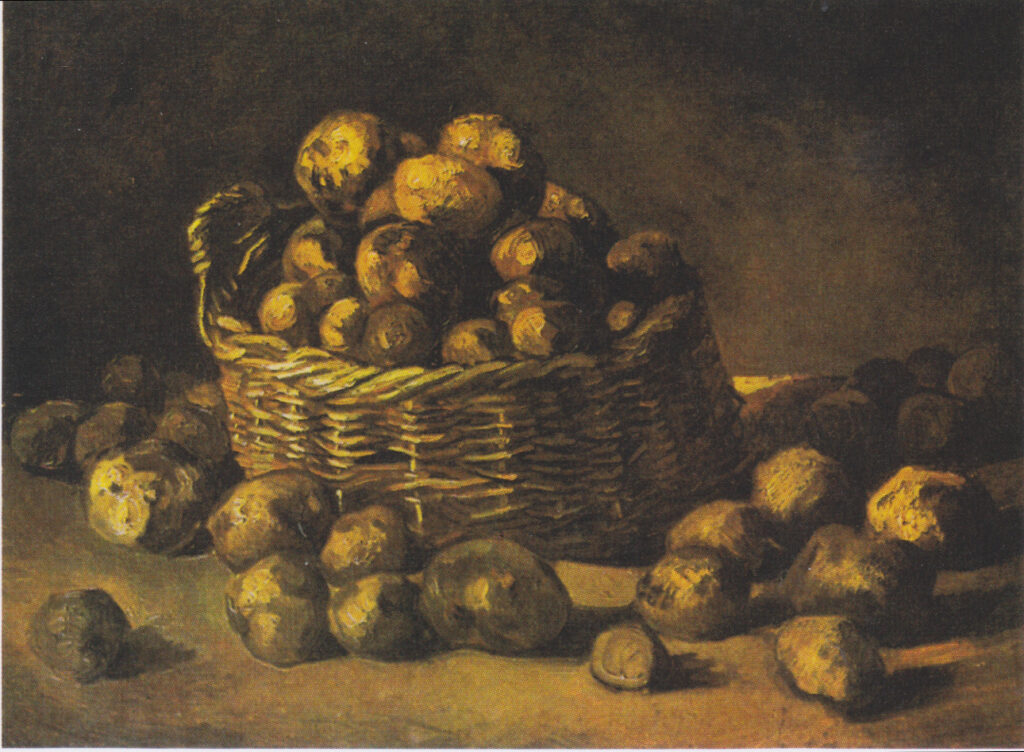
From that period in his artistic development comes Still Life With Potatoes, which he painted in 1885. The colors are muted, and the potatoes are rendered with traditional realism. The harbingers of van Gogh’s future visual power and originality are only signaled in his treatment of light and the dynamic composition of the brown tubers spilling out of the basket. It is an interesting picture but still very traditional. Van Gogh continued the potato theme in several still lifes as well as in his famous The Potato Eaters, a picture that he considered as his crowning achievement in learning the craft of portraiture. In a letter to his brother Theo, van Gogh called himself a “peasant painter,” believing that his destiny was to live among these Brabant farmers and paint their life and surroundings.
He was wrong about his future. A few years later, van Gogh would have under his belt a stay in Paris, where he studied the craft and discovered Impressionism. Eventually, in February 1888, he arrived in Arles to discover such incredible sunlight as he had never experienced before. This led to the explosion of visual prowess and extreme originality that made van Gogh the artist we know today.
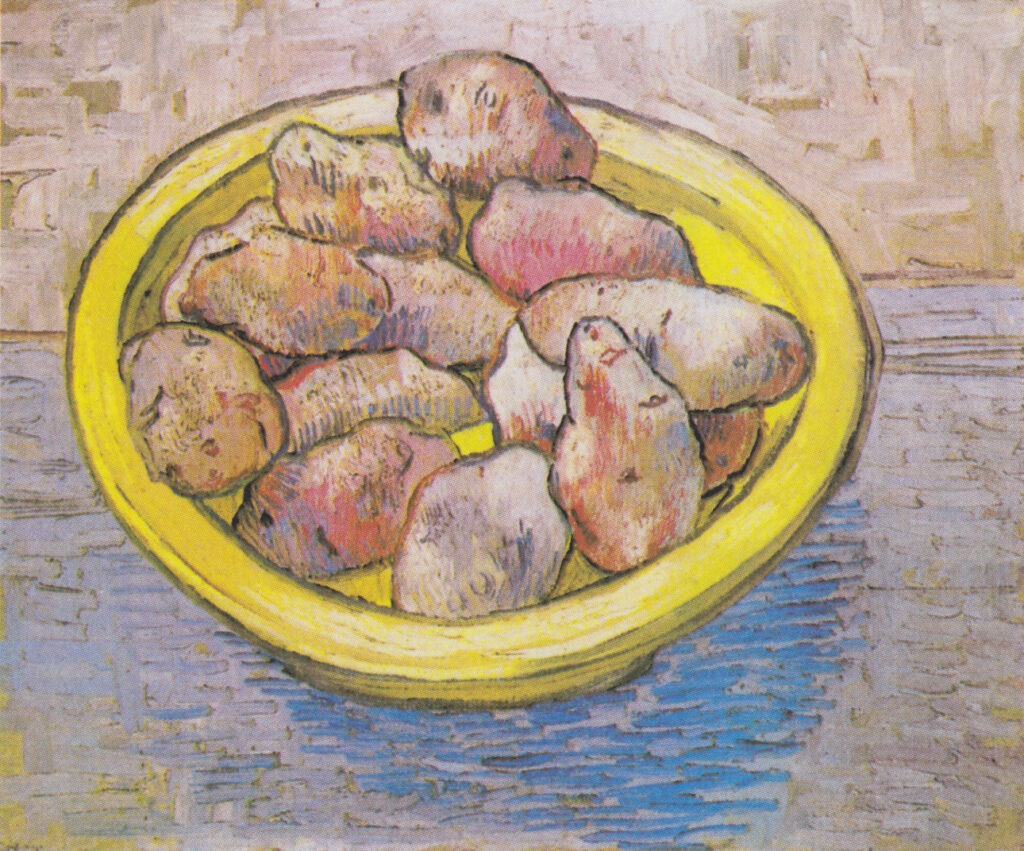
How much his style changed in those three short years is clear in another Still Life with Potatoes, painted in March 1888, barely a month after his move to Arles. These are still plain potatoes, but the muddy basket has been replaced by a bright yellow bowl (the color that he discovered on arrival in his first Provençal house, all painted bright yellow) and the potatoes themselves are no longer painted in a naturalistic manner. They have a thick black contour, a painterly device possibly influenced by Gauguin, befriended and admired by van Gogh, at least until their famous falling out. The colors are so different from the Nuenen palette—gone are the browns and greys, even though potatoes themselves would still actually be this earthen color. For the artist, however, the need for a realistic presentation was gone—he had discovered a different approach to painting that history would later name Post-Impressionism, of which he would become one of the most famous representatives.
GREEN BEANS
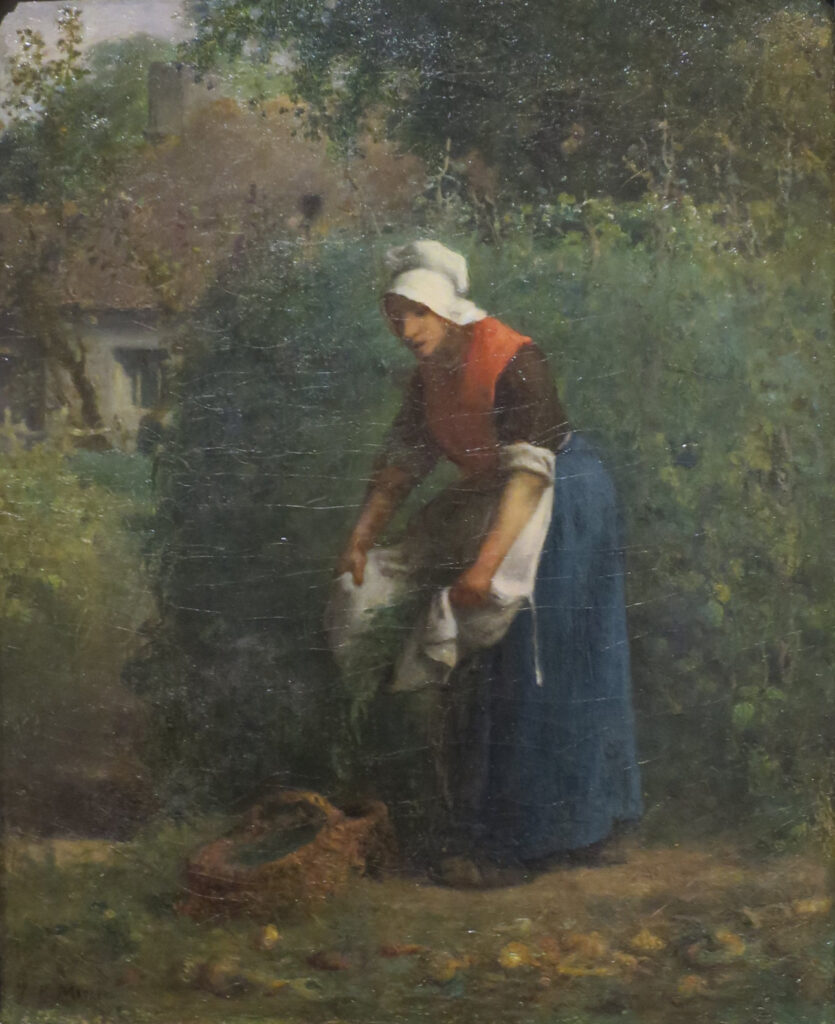
The paintings of Jean-François Millet (1814-1875) were an inspiration to such 19th-century avant-garde artists as van Gogh and George Seurat, but Millet himself did not live long enough to paint in the nascent styles of Impressionism or Pointillism. Millet’s artistic life was that of illustrating his concern for the hardships of poor people, especially the farmers he had observed from his youth on the family farm. His style was realistic but evocative, filled with spirituality and compassion. One of his most recognizable works, The Gleaners, shows the poorest village women picking leftover grains after the harvest and was typical for Millet, appealing for compassion for the hardships of rural life. In Gathering Beans, Millet shows a peasant woman carrying an apronful of freshly picked green beans. Despite the lush greenery of the garden, her slightly bent posture and sad expression show us that she is not much connected to the idyllic nature around her—she is just doing a kitchen chore, similar to many others each day. So this is again Millet using all his painterly skill and a romantic garden setting to show someone whose toil is vital for family life but also ignored.
CORN
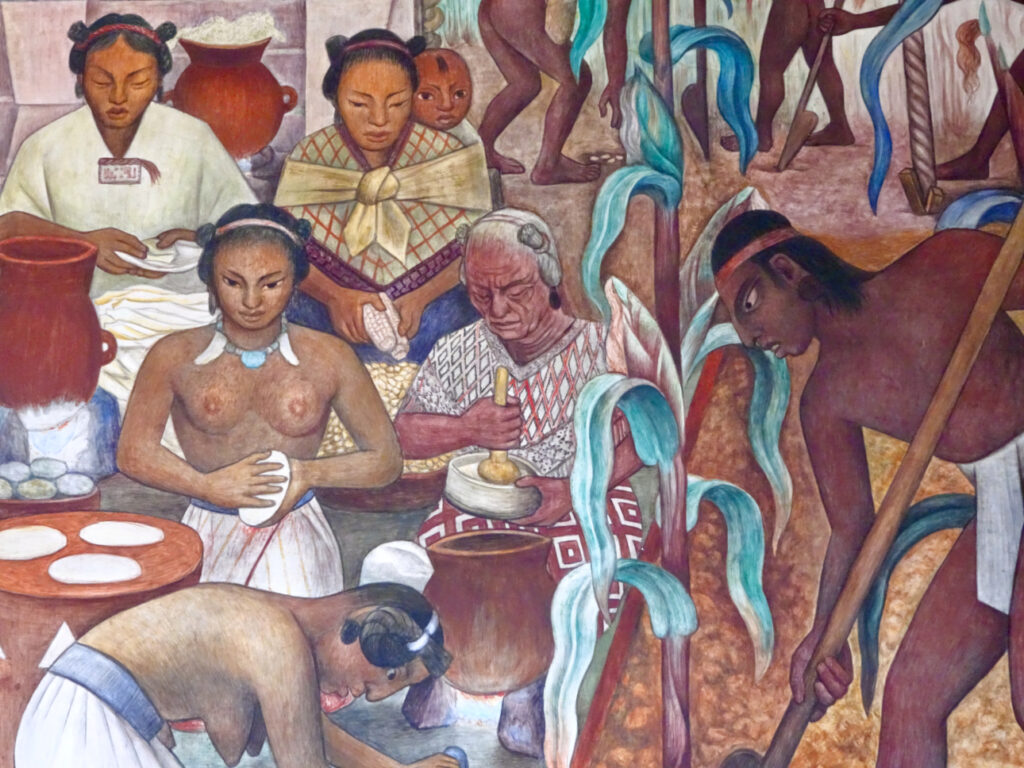
Although the cultivation of corn did not reach beyond South America until the Spanish conquista in the 1500s, the easily planted and nutritious grain became a staple of the North American diet in subsequent centuries. A mural titled Maize that Diego Rivera (1886-1957) painted at the National Palace in Mexico City shows the pre-Columbian cultivation of corn—the plant that, together with potatoes, had fed South American kingdoms for thousands of years. On the right side of the mural, an Aztec farmer is weeding around a tall cornstalk, while others are planting seeds; on the other side, Rivera shows women preparing the most typical product of corn: tortillas, as well as the local atole beverage made from mashed corn. The full mural also shows Teocintle—the spirit of corn presiding over the fields. Rivera painted scenes of cultivation and use of corn in murals on the palace stairwell as early as 1924. Throughout his artistic career, he would return to images of ancient farming as a way of paying homage to Mexican culture and its Aztec heritage.
SQUASH
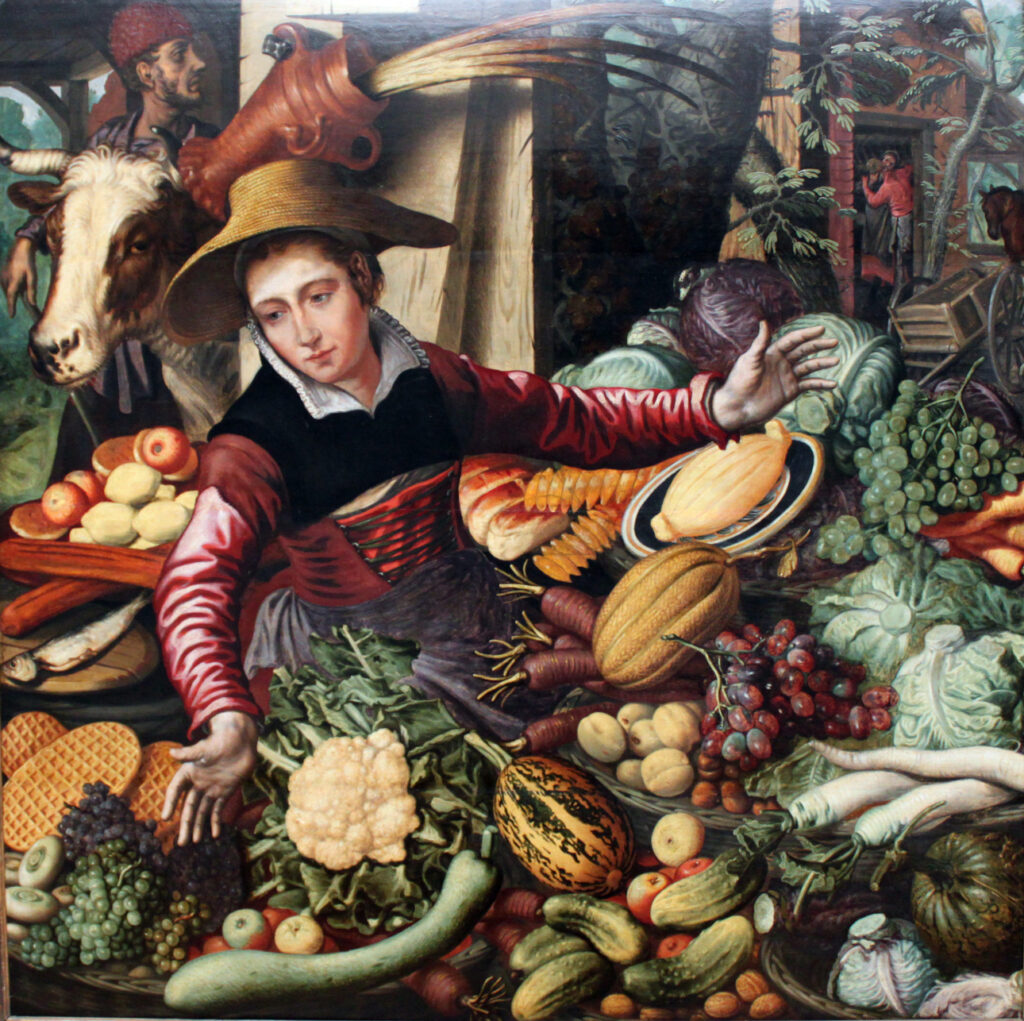
When Pieter Aertsen (c. 1506-1575) painted this market stall overflowing with all kinds of vegetables, both the subject and genre were quite unusual for the mid-1500s. Aertsen was a master of presenting images of vegetables, even though at the time they were considered peasant food. Rich people avoided vegetables on their tables, considering such food too simple and possibly unhealthy. Aertsen, who was a pioneer of peasant scenes that often included biblical characters in the landscape, had no qualms about presenting humble foodstuffs in a most grand manner. His domestic scenes of cooking preparations, as well as portraits of various market sellers, were more elaborate than anything before him.
Many paintings during the Dutch Baroque era carried moralistic messages about the transitory nature of worldly goods or showed the contrast between pious, hard-working merchants and lazy servants or distracted lovers. The Vegetable Seller does indeed carry a message about the ephemeral nature of earthy products, but this moralistic subtext, which would have been obvious to any Aertsen contemporary, is now lost to us. What remains is this cornucopia of appealing farm products. A young woman is presenting them to us, opening her hands like a magician. The squashes, carrots, and cabbages are positioned at a slant as if they were spilling toward us. It’s a true cornucopia of abundance. The mood of the image is sensual and happy, despite the underlying moralistic reminder.
TURKEY
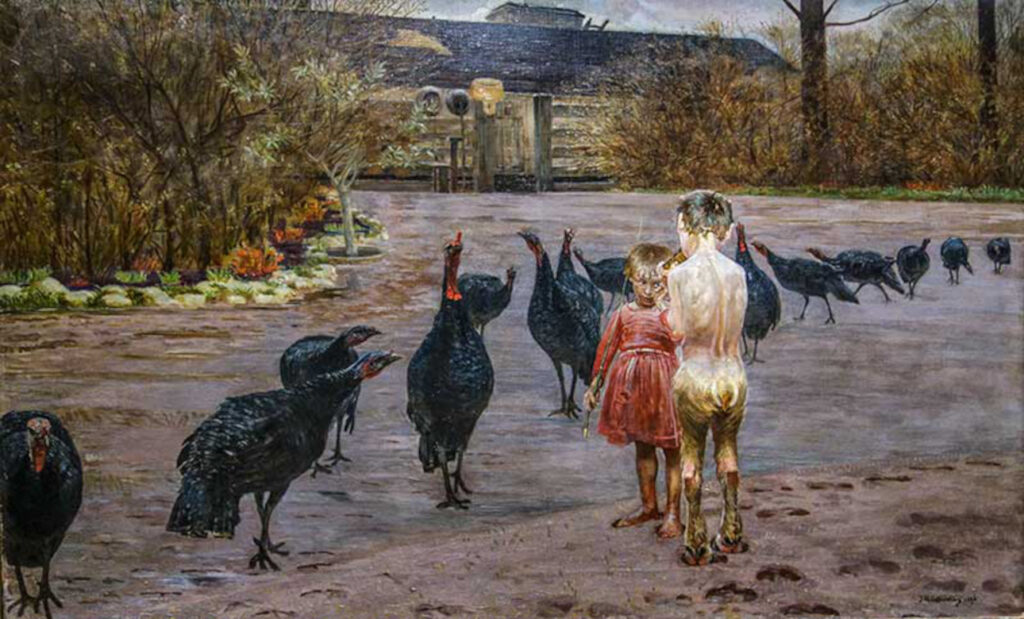
Even at the most casual glance, we can see that Art in the Manor is a Symbolist picture. Although it does present in a realistic manner a small girl minding her flock of turkeys, her encounter with a faun tells us immediately that this is a fantasy. The title says even more. The boy-faun who has appeared in front of the slightly scared girl is here to represent the whimsical, the unusual, and the mythological—in other words, he is a symbol of art. He shows up in the most unlikely setting, not among the gods of antiquity but facing a dirty child in a muddy village. Perhaps this is about art that can appear anywhere and in the most unexpected manner, or perhaps this is an admonishment that life in the poorest villages is deprived of culture or, in fact, of anything that goes beyond daily existence.
Art in the Manor was painted in 1896 by Polish artist Jacek Malczewski (1854-1929). His symbolic art, on the cusp of the 20th century, was in line with the philosophical and artistic trends of that time. Psychologists like Freud had started to reveal our inner world, painters like Munch had expressed on canvas our subconscious anguish, and writers like Baudelaire had said similar things in poetry. Malczewski’s paintings often placed mythological figures in contemporary settings—the villages, meadows, and rivers of the Polish countryside. His mixing of the symbolic figures of death, muses of art, or allegories of patriotism with figures of people resulted in paintings that are like dreams—full of living, familiar people interacting with messengers from the subconscious. Art in the Manor is one such picture, where the encounter of a faun and a child is entirely dreamlike. Even the turkeys, although painted so realistically, are encircling this pair in a completely unrealistic, disquieting manner.
CRANBERRIES
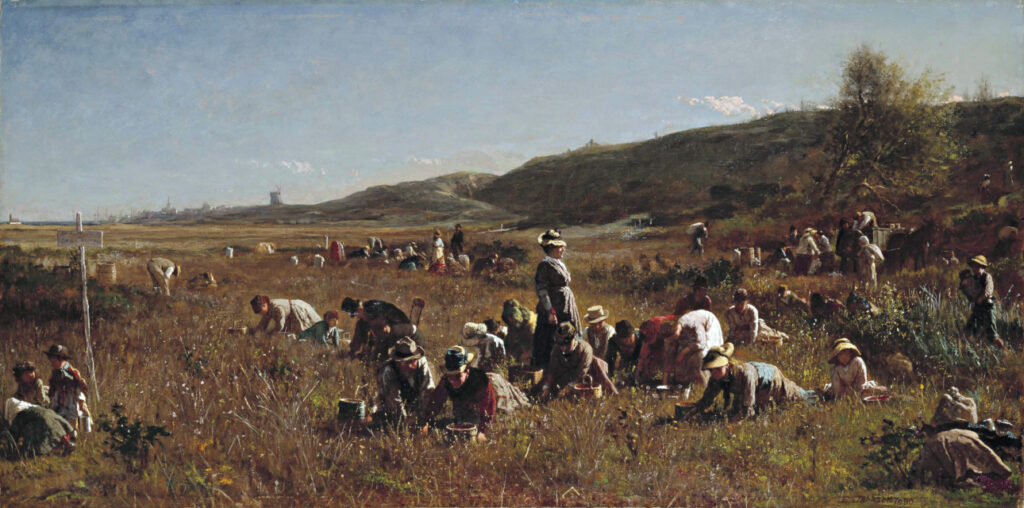
Jonathan Eastman Johnson, one of the most prominent 19th-century American painters, spent time living and studying in The Hague. He has sometimes been hailed as an “American Rembrandt” for his classical style and mastery of brushwork. Although he painted many portraits and historical scenes, some of his most famous canvases depict scenes from life in his native Maine and other East Coast locations. He would paint farmers husking corn, spinning yarn, or churning butter. He painted several scenes of cranberry harvesting, which involved large parties of mostly women and children crawling among low bushes with special sieves. Johnson portrayed this mundane activity in the Dutch Baroque style that he absorbed during his European studies. The light is diffuse, while the cranberry fields are bathed in a golden color and the groups of pickers are posed as if in an Old Master biblical scene. There is hard work but also a lot of calm in this scene.
Through these paintings, we have thus composed a Thanksgiving menu—a feast for the eyes to supplement the joys of real holiday dishes.
Happy Thanksgiving!