Food for the Soul: Raphael at the Met
By Nina Heyn
If you want to learn about fine art, sometimes it is best to start with the basics. Getting familiar with Raphael (Raffaello di Giovanni Santi, 1483-1520) constitutes just such a “basic” because, alongside a dozen other artists throughout history, his works are not only some of the most alluring but also seeded many ideas about beauty, artistic composition, and color. For centuries, Raphael’s work has offered that intangible sensation that we are looking at the utmost that the human eye and hand can achieve. Since Raphael’s time, artists have always known that it would be hard to top his mastery. Even 20th-century grands such as Hockney or Picasso began their early careers by studying Raphael’s drawings.
The exhibition that has just opened at the Metropolitan Museum of Art in New York can remind everybody—the public and artists in equal measure—that going back to the basics of Western art is important. Raphael: Sublime Poetry is an ambitious, landmark exhibition; it is the first-ever major international loan show of the artist’s work in the United States. It comprises over 200 paintings, drawings, tapestries, decorative arts, and architectural sketches, together with numerous reference artworks by Raphael’s teacher Perugino and other Renaissance contemporaries who were his collaborators, or, like da Vinci and Michelangelo, served as points of reference. The loans include works from such major sources as the Louvre, the National Galleries in Washington and London, the Ashmolean in Oxford, as well as various European museums.
The fact that Raphael was one of the most talented artists in history is hard to discern on the basis of a random Madonna painting seen at a gallery among other famous pictures. For a more holistic view of all that Raphael brought to art history, you’d have to visit his Vatican frescoes, see his numerous religious and decorative paintings, and view his cartoon designs and sketches. This major loan exhibition does the trick, showing the scope of the artist’s achievements in one place, and probably showcasing his work even better than would have been possible during Raphael’s lifetime—because back then, he would have sent out completed works to patrons or left his completed decorations and moved on.
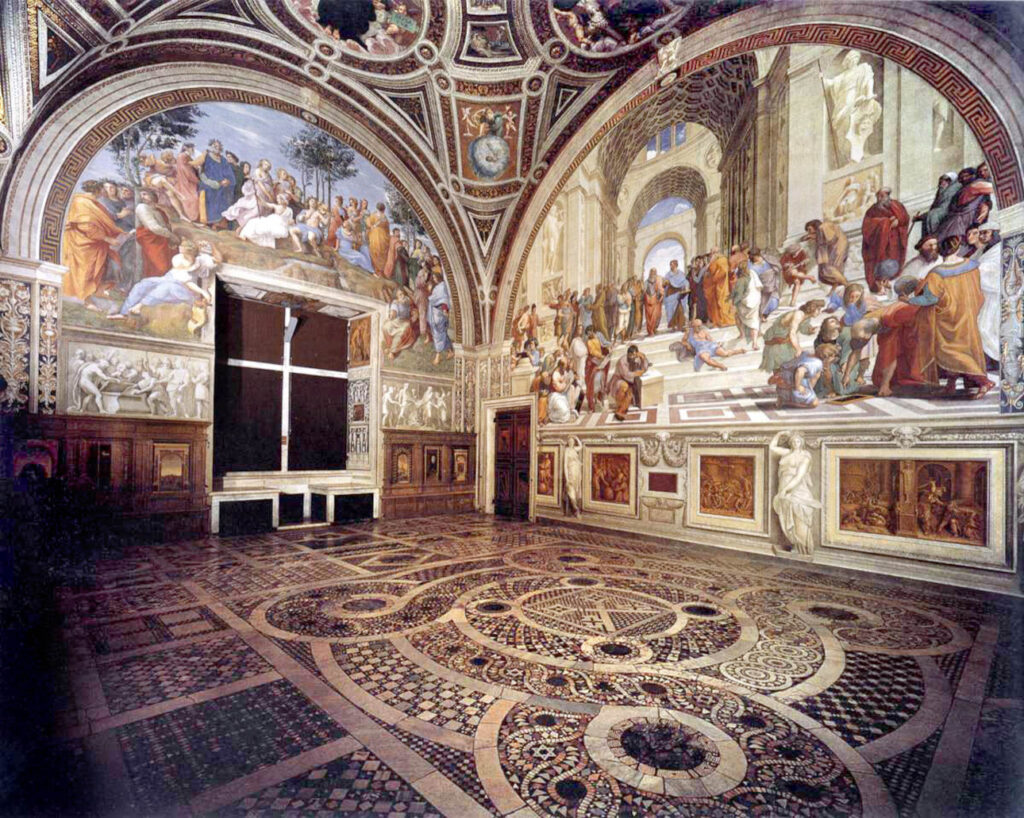
There is no really good way to experience Raphael’s famous Vatican frescoes other than to actually see the originals in place, but the exhibition makes a good attempt by creating a room where the Vatican stanzas (rooms) show up on life-size screens. Images that form the frescoes of the four stanzas (Segnatura, Eliodoro, Incendio, and Costantino) alternate on-screen every 15 seconds. It might be a good selfie site except that the images alternate a bit too quickly for the frescoes to be appreciated properly, either for a photo or for admiring the images themselves.
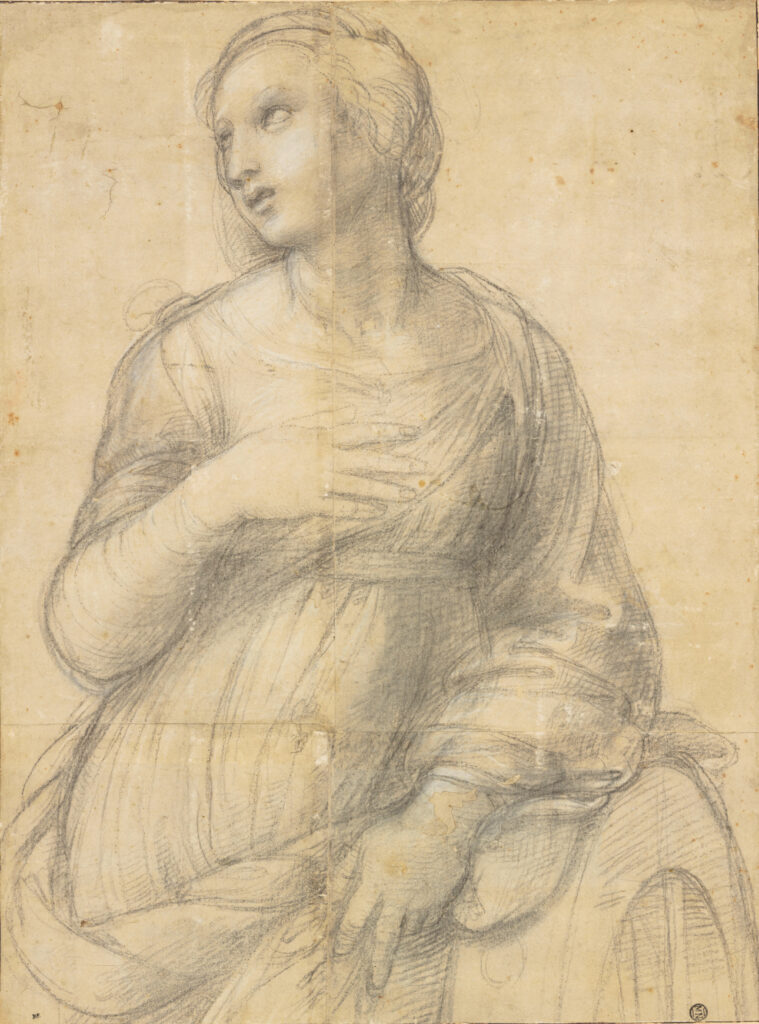
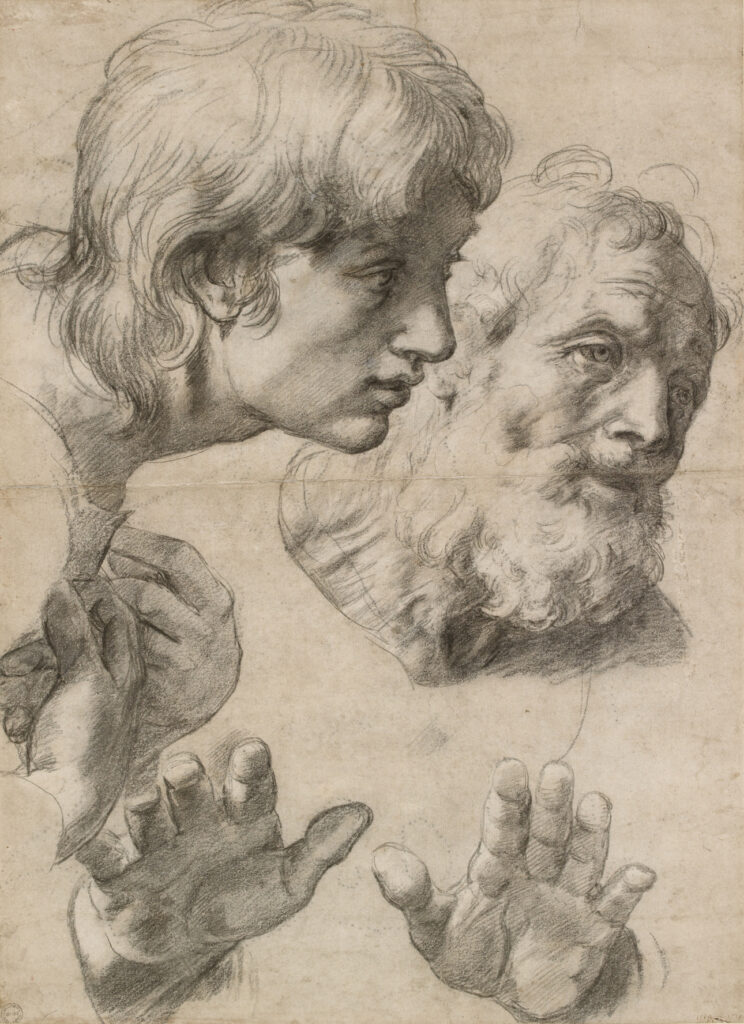
Perhaps the greatest strength of this show lies in its assembly of so many Raphael drawings. His exceptional draftsman’s skills served him from the earliest days when he was still apprenticed to Perugino, who would entrust him with the design of a project that the master would later paint himself. Throughout his life, Raphael would draw sketches when working out compositions or gestures of figures, when designing architectural plans, and when documenting Roman ruins. Luckily, Raphael did not destroy his preparatory sketches (unlike Michelangelo, who spent his long life erasing any traces of his prep work to enhance his reputation as an infallible master), so we have examples of his plans for altar compositions, ideas for frescoes and tapestries, and phases of design for his paintings. A piece of chalk must have been always close at hand; even his finished oil canvases show on X-ray some underdrawings. He was a draftsman first, and no painting or design seems to have been done without him trying out elements, compositions, and versions in dozens of sketches.
When Pope Leo X wanted to persuade the French King Francis I to join the fight against the Turks, he would send this Italian-art-obsessed royal collector some Raphael paintings. It seems that a Renaissance pope, a king, and a duke had the same taste as contemporary art lovers. If you like fine art, there is nothing more pleasing than a Raphael painting. And this is what the Met show delivers by bringing some famous Madonnas but also featuring three portraits that sum up Raphael’s ability to create pictures that still tug at the heartstrings 500 years later.
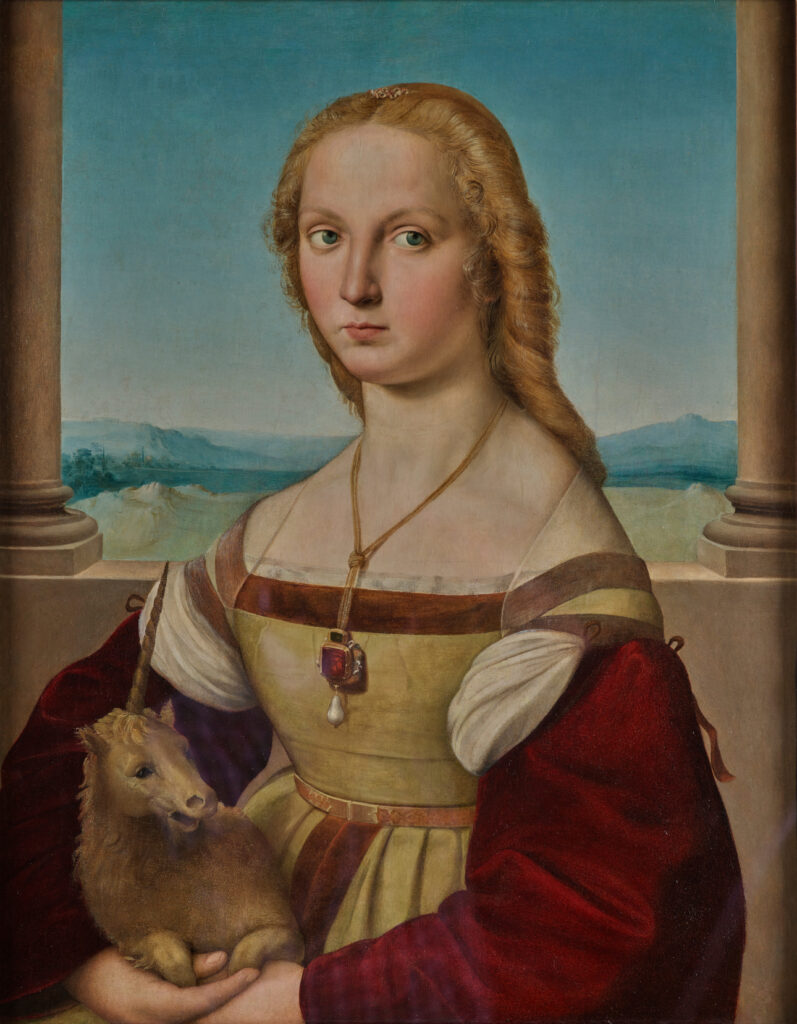
Portrait of a Lady with a Unicorn from the Roman Galleria Borghese shows echoes of Leonardo’s Dame with Ermine and the Mona Lisa. Raphael spent some time in the company of the old master during his first stay in Florence in the early 1500s, and he would have seen these paintings or at least preparatory sketches. Lady with a Unicorn is an early work that underwent several transformations. Originally, Raphael painted this as a portrait of a young woman, possibly a bride-to-be as indicated by the lack of rings on her fingers. The animal was initially a dog (a symbol of fidelity), but the artist changed it later to a mythical unicorn (a symbol of chastity), which makes this picture both a portrait and a metaphor and as enchanting as Leonardo’s Dame with Ermine. Some time in the 1700s, the unicorn was overpainted, transforming the woman into St. Catherine, complete with a wheel and a palm frond, and it remained like that until the 1930s when the overpaint was removed and the cute unicorn discovered.
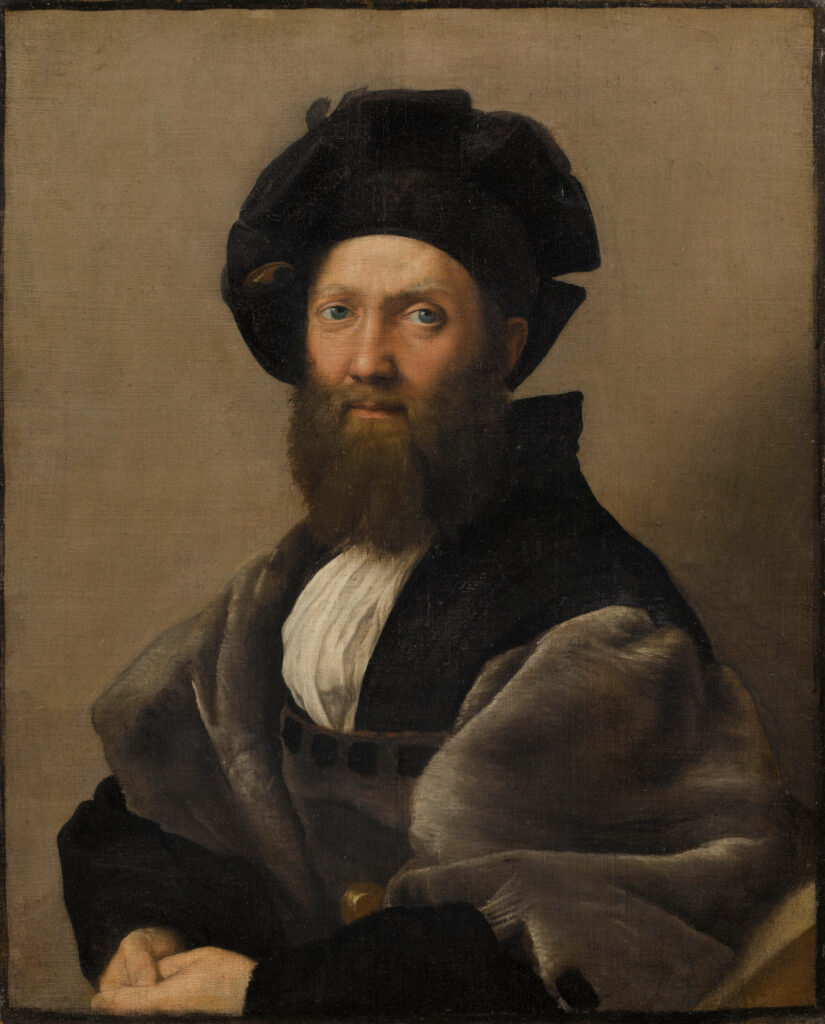
As far as Raphael’s portraits go, his youthful portrait of a girl, charming but not hugely different from the style of his mentor Perugino, is in huge contrast to his mature work in Portrait of Baldassare Castiglione. Painted some time between 1514-19 (that is, when the artist was in his thirties and at the peak of his artistic powers), this is a portrait of a scholar and courtier. Raphael was portraying a close friend, taking care to show him in the best way possible, masking his balding head with a beret and making his piercing and unusual (for Italy) blue eyes the focus of the picture. The tone is kept monochrome—all blacks, browns, and greys—the better to offset the impossible blue of the eyes and show off the mastery of rendering the velvet’s smoothness and the fur’s sheen. This portrait is no longer an example of the early Renaissance figurative art that tended to focus on external appearance, with colorful cloaks in complicated folds, nor was it done to showcase an attribute (such as piety in a saint or suffering in martyrdom)—this is a psychological portrait delving into the inner life of the subject. Many of the grand masters who came later—such as Titian, Rubens, and Rembrandt—would take up this artistic challenge in direct or oblique reference to Raphael’s masterpiece.
When da Vinci painted portraits of women, the pictures started out as commissions for his patrons, even if some, like the Mona Lisa, were never delivered to the client. Raphael’s portraits, like the one of Baldassare Castiglione or his double portrait of scholars Andrea Navagero and Agostino Beazzano, were works he did for private use as tokens of his friendship. He had a reputation as an easygoing man who got along well with almost everybody: employers and employees, men and women. Especially women.
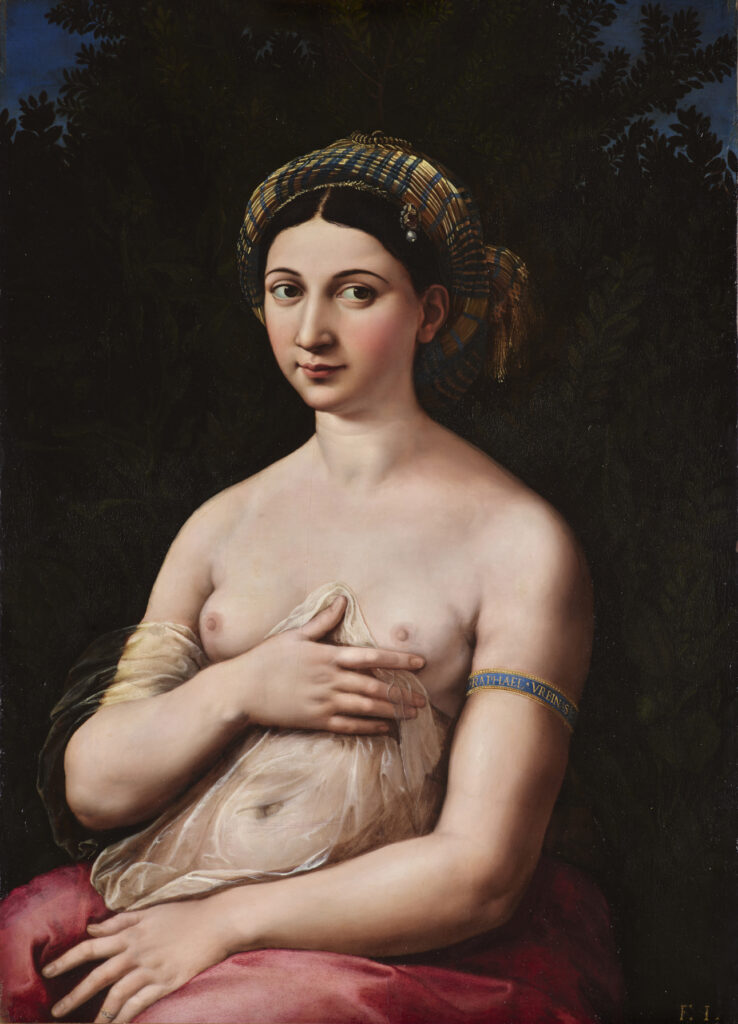
It is believed that La Fornarina is a picture of Raphael’s lover, the daughter of a baker (hence the portrait’s nickname), or perhaps just a portrait of a woman as a goddess of love—over the centuries, art historians have bickered over this point. At the end of the day, however, it is the picture itself that speaks to us about Raphael’s passions, in a voice much stronger than any academic footnote. This one is definitely a picture for private enjoyment (it was, in fact, covered with wooden shutters until the 17th century). The doe-eyed beauty is making a half-hearted attempt to cover her nudity with a muslin veil in a gesture attributed since antiquity to marble statues of Venus Pudica. An armband with Raphael’s full name identifies her as belonging or connected to him; the myrtle, quince, and laurel leaves behind her are all symbols of love (the artist originally painted a landscape behind her but then erased it), so it is quite credible that this is an intimate portrait of a lover. He did, after all, on his deathbed make a will providing funds for his girlfriend, quite possibly the one who is shown with such passion and care in this exquisite picture.
These three portraits at the exhibition show Raphael’s private side—what he painted on his own time, in between altarpieces, architectural designs, and his Madonnas. Ah, Raphael’s Madonnas… paintings that have been copied, engraved, printed, and reproduced for centuries, for the fancy decoration of city apartments and for pious grandmas’ rooms in villages in many parts of the world.
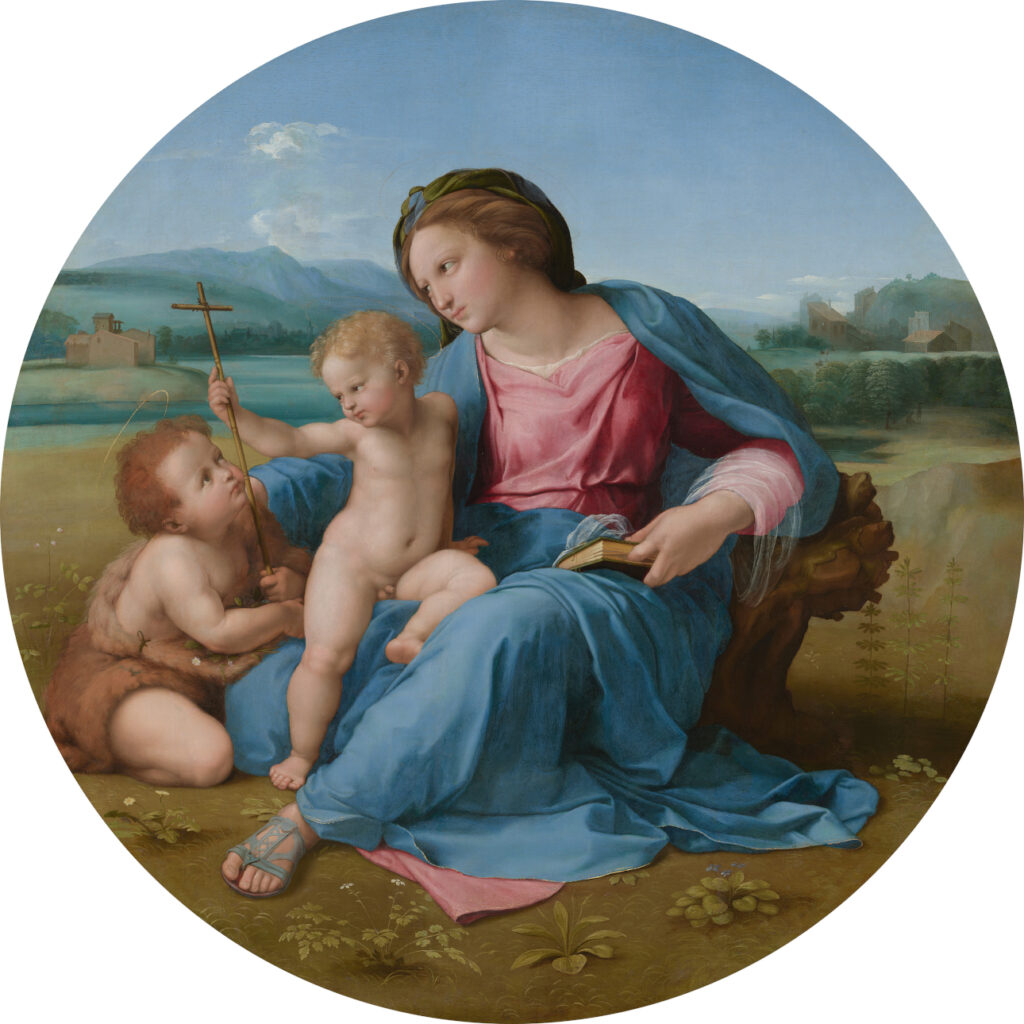
No Raphael show can be complete without examples of the Madonnas that he painted throughout his life, from early and more conventional altar pieces, to smaller, exquisitely composed devotional pieces, to the large compositions like Madonna di Foligno at Pinacoteca Vaticana. To see how far Raphael traveled on his artistic path from his mentors and contemporaries, the exhibition includes a Madonna painted by his teacher Perugino when the teenage Raphael was apprenticed to him.
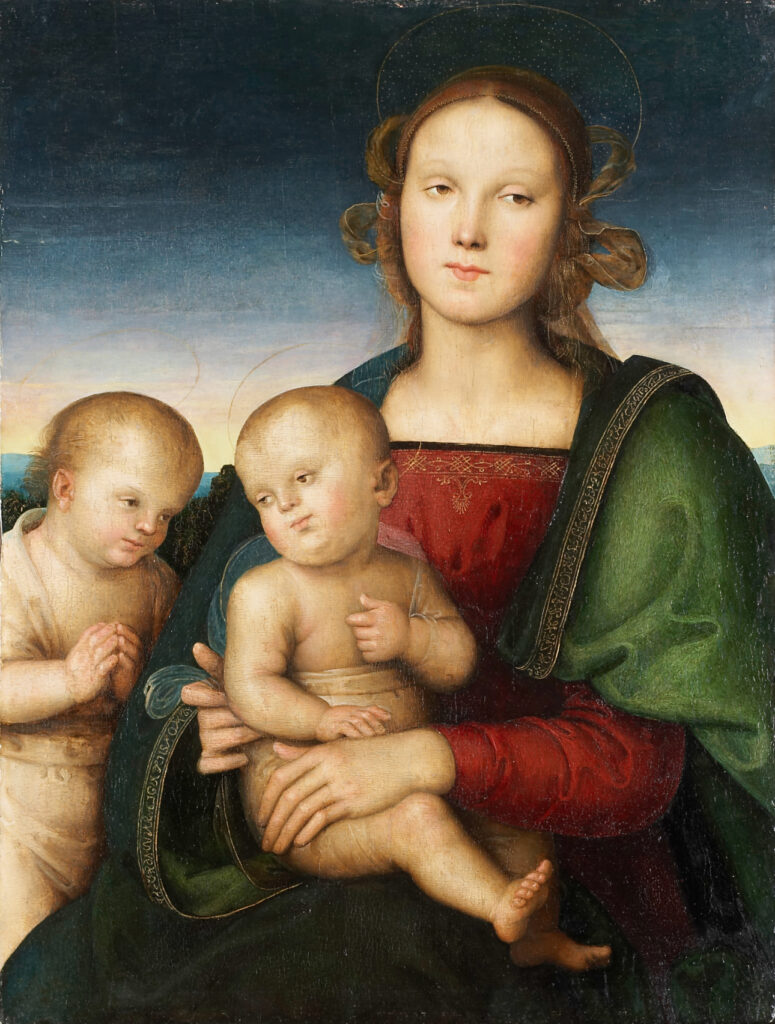
Perugino’s painting fits within the accepted formula for devotional works of the period, showing both the Infant and John the Baptist as divine figures that one would pray to, but not really interacting with the viewer. Perugino’s pupil would soon surpass him by imbuing this traditional theme and composition with his own sensitivity and viewpoint.
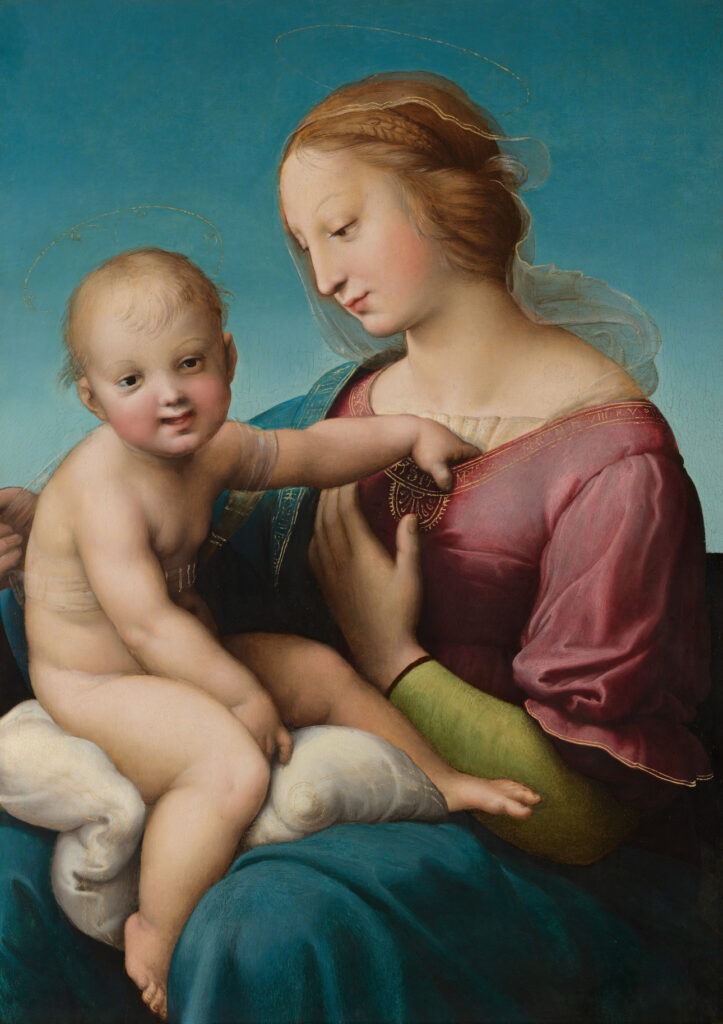
In probably the last painting that Raphael painted before leaving Florence for Rome, the so-called Large Cowper Madonna, the figure of the infant is not a religious symbol. Or at least not only a religious image. We see a perfectly painted, sweet baby who reaches out toward his mother’s dress (perhaps to initiate nursing? Babies tend to grab at mother’s clothes when they want to nurse) and who turns toward the viewers, engaging fully with the world at large—aware and full of life, even if we know that it will be cut short at the end. Raphael was one of the first artists to break with the tradition of previous centuries of portraying the infant Jesus as a martyr, a harbinger of future suffering, a creature half-divine and half-human. If you look at the Madonnas of just a few decades before Raphael, the divine baby often does not look like a baby at all, or at least not as sweet and human as those done by this artist.
In modern times, perhaps starting as early as the 19th century when Dante Gabriel Rossetti started an art movement of “Pre-Raphaelites” (that is, embracing a style that would avoid Raphael’s “sweet perfection”), the fame and respect due this artist have been obscured somewhat by his two other contemporaries—Leonardo da Vinci and Michelangelo. Exhibitions like the one currently at the Met (and a couple of earlier ones in Rome and London) show Raphael as a Renaissance artist whose scope of artistic versatility and innovative influence easily matches that of Michelangelo and Leonardo.
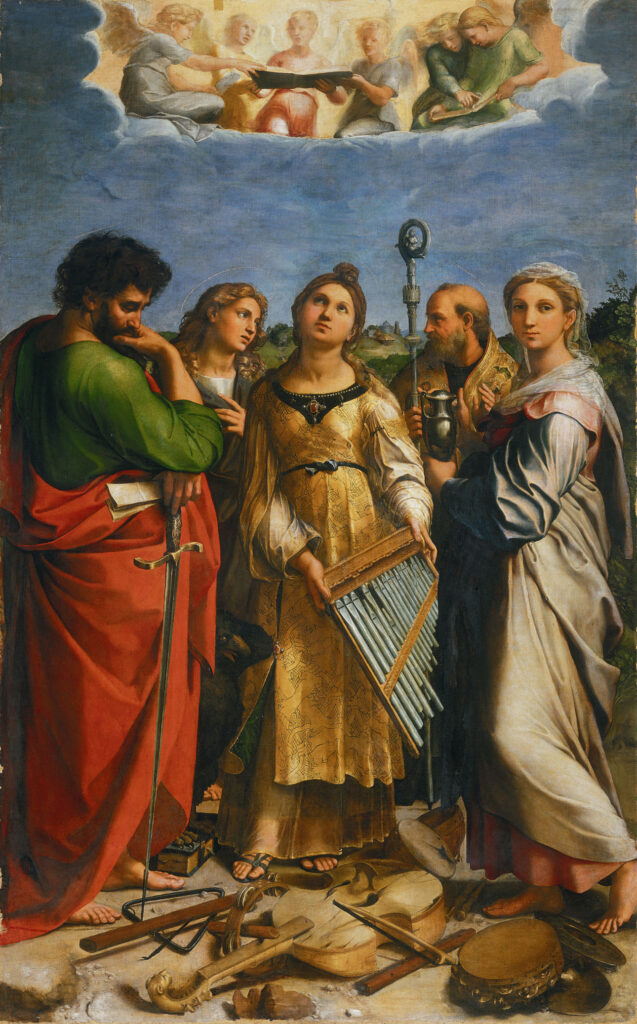
The exhibition, Raphael: Sublime Poetry, is at the Metropolitan Museum of Art in New York between March 29 and June 28, 2026.